Scheduled to work outside at night with 〜ことになる
Grammar Explanation: To end up being with 〜ことになる
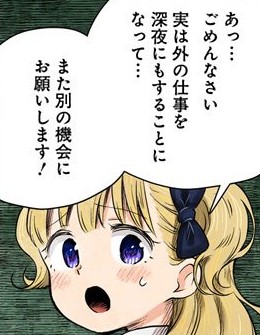
Kate says she wants to study together with Emiriko before bedtime.
- エミリコ:
- 「あっ… ごめんなさい。実は外の仕事を深夜にもすることになって…」
- “Ah, I'm sorry. The truth is, I'm scheduled to do late-night work outside...”
- Literal: “Ah... I'm sorry. Actually, it has become the thing that I also do outside work late at night...”
- 「また別の機会にお願いします!」
- “Please ask again another time!”
Key Points
- 外の仕事を深夜にもすることになって means Emiriko has been scheduled to work outside late at night too.
- The sentence trails off because this explains why she cannot study now.
- 実は signals that she is revealing the actual scheduling conflict.
- It softens the refusal before she apologizes.
- また別の機会に means “another time”.
- お願いします keeps the refusal deferential toward Kate.
Vocabulary
実は (Actually)
実は introduces the truth, often something the listener did not know: “to tell the truth”.
外 (Outside)
外 is the outside of something, or outdoors.
仕事 (Work)
仕事 is work done for a living, or a particular task one has to do.
深夜 (Late night)
深夜 means late at night, usually after midnight.
する (To do)
する is to do or perform something. It also turns many nouns into verbs, as in 勉強する.
こと (Thing)
こと is an abstract thing, matter, or fact, as opposed to a physical object. It also turns a verb phrase into a noun, as in 見たことがある. It is also written 事.
なる (To become)
なる is to change into a different state or become something. It also means something turns out a certain way. It is also written 成る.
また (Again)
また means “again” or “once more”. It also means “also”. As a goodbye, またね means “see you”.
別 (Separate)
別 means another or different one: “separate” or “other”.
機会 (Opportunity)
機会 is a good time or chance to do something.
See Also
- Grammar: To end up being with 〜ことになる
- Grammar: Polite style with です and ます
- Grammar: Marking the topic with は and も
- Future entry: Transitivity in Japanese
- Grammar: Compound voicing with 連濁
- Kanji: Matters and events with 事
- Kanji: Meeting and joining with 会