Seasonal uniform change contest with 勝負
Vocabulary Explanation: Words for competition (Future entry)
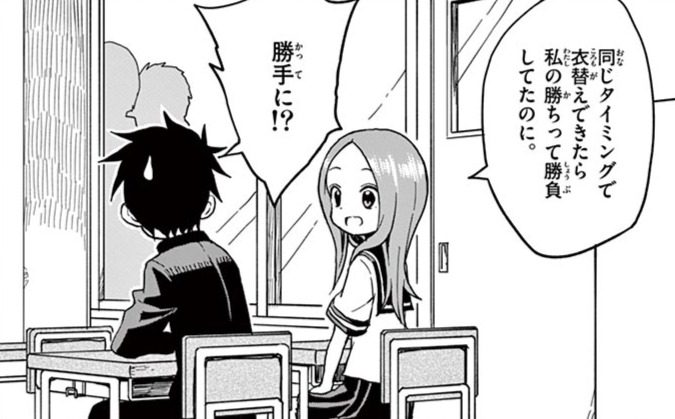
Nishikata arrives at school wearing his winter school uniform. He finds Takagi still wearing her summer uniform. Nishikata’s reason for the switch is that he heard the weather forecast for cooler temperatures. Takagi laments her carelessness.
- 高木:
- 「同じタイミングで衣替えできたら私の勝ちって勝負してたのに。」
- “We had a contest going where if we switched uniforms at exactly the same time, it would count as my win.”
- Literal: “Even though we were having a contest where, if we managed to do the seasonal uniform change at the exact same timing, it would be my win.”
- 西片:
- 「勝手に!?」
- “You just decided that on your own!?”
- Literal: “On your own!?”
Key Points
1勝負してた uses the noun 勝負 as a verb
- 勝負する means to have a contest that decides a winner and loser, and してた (from していた) shows the contest was already underway in Takagi’s mind.
2できたら sets the contest’s winning condition
- 同じタイミングで衣替えできたら states the condition: if they managed to switch uniforms at the same time.
3って marks the rule Takagi made up
- 私の勝ちって quotes the terms of the contest: meeting the condition counts as her win.
4のに expresses Takagi’s disappointment
- Ending the sentence with のに conveys her regret that the contest fell through when Nishikata switched first.
5勝手に protests a one-sided decision
- 勝手に means doing something on one’s own without consulting anyone; Nishikata never agreed to this contest.
Vocabulary
出来る (To be able to)
出来る means to be able to do something. It can also mean that something is made, completed, or comes into existence.
私 (I)
私 means “I” or “me”. It is the standard first-person pronoun in polite speech and is also common in casual speech among women.
勝負 (Match)
勝負 means a contest, match, or showdown that decides a winner and loser.
See Also
- Future entry: Past tense with 〜た・〜だ
- Kanji: Privacy and self with 私
からかい上手の高木さん © its respective creators. It is used here for educational commentary.