Securing drinking water was hard with 〜そうだ
Grammar Explanation: Hearsay with 〜そうだ
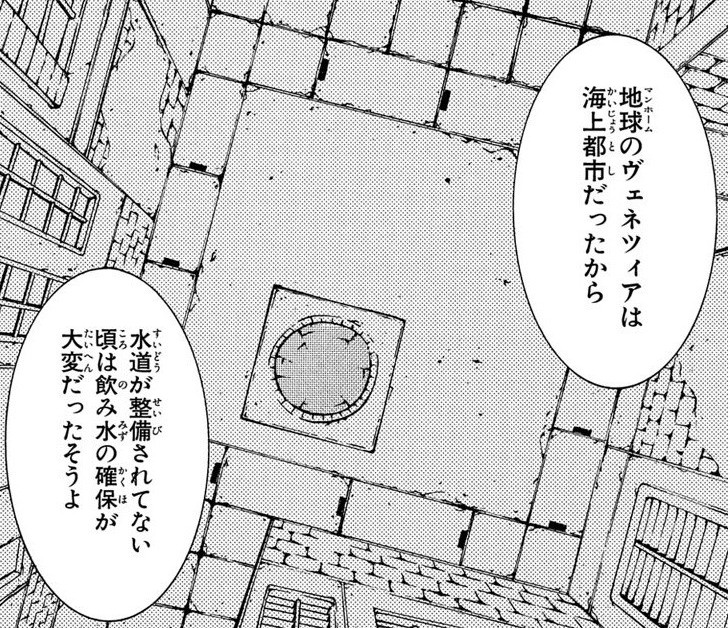
Al shows up late to meet Aika after working overtime, and the two walk the quiet streets at night. Aika climbs onto an old well in a plaza, its rotten cover gives way, and she drops in. Al reaches down to help her out and tumbles in after her. Luckily the well is dry. As Aika tries to climb the stone wall, Al remarks that the town’s wells have covers because no one uses them anymore.
- アル:
- 「地球のヴェネツィアは海上都市だったから」
- “Venice on Manhome was a city on the sea...”
- 「水道が整備されてない頃は飲み水の確保が大変だったそうよ」
- “...so I hear getting drinking water was really hard back before they had a water system.”
Key Points
- そうだ after a complete plain-form clause means “I hear that…” or “apparently…”. Al wasn’t there. He is passing on history he learned.
- The clause before そう can be past tense. 大変だったそう reports that something was hard. The hearsay itself stays in the present.
- In casual speech, the だ drops before よ, giving そうよ.
- Compare 大変そう, with そう on the stem. That would mean “looks hard”, a guess from appearance.
- 整備する is “to set up” or “to maintain” infrastructure. 整備される is its passive, “to be set up”.
- されてない is a casual contraction of されていない, “hadn’t been set up”. The ている describes a state.
- 〜頃は means “back when…”, so the whole phrase is “back when the water supply wasn’t in place”.
- The first balloon ends in から, giving the reason. Because Venice was built on the sea, fresh water was hard to come by, even though the city was surrounded by water.
- 地球 is the series’ name for Earth. The kanji 地球 are written with the reading マンホーム.
Vocabulary
ヴェネツィア (Venice)
ヴェネツィア is Venice, the city in northeastern Italy built on islands in a lagoon. It is also written ベネチア.
頃 (Time, days)
頃 is a period or point in time, as in 子どもの頃, “when I was a child”. After a time expression it is read ごろ and means “around”, as in 三時頃.
飲み水 (Drinking water)
飲み水 is water that is safe to drink.
大変 (Serious)
大変 describes something serious or hard to deal with. As an adverb, it means “very”.
そう (So)
そう means “like that” or “that way”. Said alone, it agrees: “right”. After a verb stem or adjective, it means something looks or seems a certain way.
See Also
- Grammar: Hearsay with 〜そうだ
- Grammar: Because with 〜から
- Grammar: Receptive verbs with 〜れる
- Grammar: Ongoing actions and resulting states with 〜ている
- Grammar: Informing with よ
- Kanji: Earth and places with 地