Sending retired gondolas to the heavens with 還す
Vocabulary Explanation: Going home and giving back with かえる
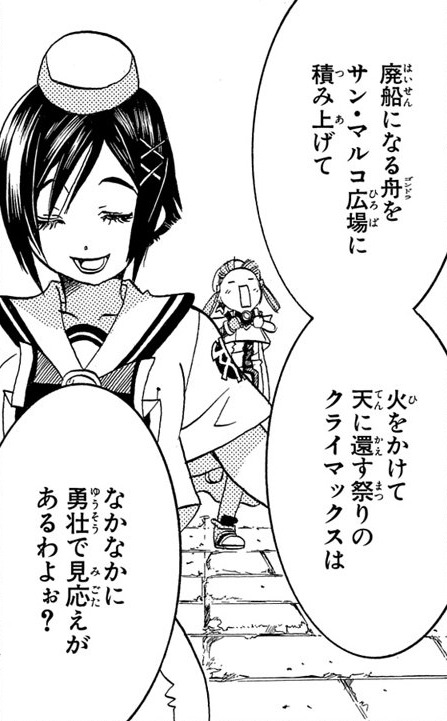
Summer is ending, and Akari, Aika, and Alice are out together on the canals of Neo-Venezia. Akari mentions a big festival this weekend. Aika names it, the “gondola fire send-off”, and says that even festival-loving Neo-Venezia holds it only once every few years.
- 藍華:
- 「廃船になる舟をサン・マルコ広場に積み上げて」
- “They pile the gondolas being retired in San Marco Square...”
- 「火をかけて天に還す祭りのクライマックスは」
- “...and the festival's climax, when they set them on fire and send them back to the heavens...”
- 「なかなかに勇壮で見応えがあるわよぉ?」
- “...is pretty stirring and well worth seeing, you know?”
Key Points
- 還す is the transitive partner of 還る. 還る is a thing returning to its source, and 還す is someone sending it there. The festival sends the gondolas up in smoke to the heavens, 天に.
- The 常用漢字表 gives 還 only its reading カン, so 還す is an unofficial spelling. Standard writing would use 帰す or 返す. Manga pick 還 for returning something to where it all began, like 土に還す, “lay to rest in the earth”, and 海に還す, “return to the sea”.
- The gondolas aren’t going home, and they aren’t being handed back to an owner, so neither 帰 nor 返 quite fits. With 還, the burning reads as a send-off rather than a disposal.
- The furigana on 舟 reads ゴンドラ, not ふね. The author writes the kanji for “boat” and glosses it with the word Neo-Venezia uses, gondola. The festival’s name, 「舟の火送り」, uses the same gloss.
- 廃船になる舟 is “gondolas that become retired boats”: gondolas at the end of their working lives.
- Aika strings the steps together with て forms: 積み上げて, “pile up and”, then 火をかけて, “set on fire and”. All of that describes 祭りのクライマックス, the festival’s climax, which is the topic marked by は.
- The comment comes in the last bubble. なかなかに勇壮で見応えがある is “quite stirring and worth seeing”. なかなか means “pretty” or “more than you’d expect”, and the に after it is a slightly old-fashioned touch.
- わよ is a feminine sentence ending that presents something as worth knowing. Aika stretches it to わよぉ and ends on a rising question mark, playing up the festival to Akari.
Vocabulary
| Word | English | Meaning |
|---|---|---|
| 廃船 | Decommissioned boat | 廃船 is a ship or boat taken out of service to be scrapped, or the act of retiring it. |
| なる | To become | なる is to change into a different state or become something. It also means something turns out a certain way. It is also written 成る. |
| 舟 | Boat | 舟 is a small boat moved by oars or a pole. Large ships are usually written 船. |
| 広場 | Plaza | 広場 means a plaza, public square, or other open space where people can gather. |
| 積み上げる | To pile up | 積み上げる is to stack things up into a pile. It is also used for building up experience, results, or a record over time. |
| 火をかける | To set on fire | 火をかける is to deliberately set fire to something, such as a building or a pile of wood. |
| 天 | Heaven, sky | 天 is the sky overhead, and also heaven, the realm of the gods or where souls go after death. |
| 還す | To send back (to the source) | 還す is to send something back to where it came from, such as the earth, the sea, or the heavens. It is an unofficial spelling of 帰す or 返す, and the transitive partner of 還る. |
| 祭り | Festival | 祭り is a festival, a shrine or town celebration with stalls, parades, or other events. It is often said politely as お祭り. |
| クライマックス | Climax | クライマックス is the most exciting or intense point of a story, event, or performance. |
| なかなか | Quite | なかなか means “quite” or “pretty”. With a negative, it means something does not happen easily. |
| 勇壮 | Heroic, stirring | 勇壮 describes something bold and spirited enough to stir onlookers, such as a festival, a march, or a battle scene. |
| 見応え | Worth seeing | 見応え is the quality of being impressive enough to be worth watching, usually in 見応えがある, “well worth seeing”. |
| ある | To exist | ある is to exist or be in a place, for things and plants rather than people or animals. It also means to have something, or for an event to take place. |
See Also
- Vocabulary: Going home and giving back with かえる
- Grammar: Connecting actions with 〜て・〜で
- Grammar: Becoming with 〜くなる and 〜になる
- Grammar: Marking the topic with は and も
- Grammar: Informing with よ
- Kanji: Seeing and viewpoints with 見