Sengoku's idea of high heat with 強火
Vocabulary Explanation: Collocations for cooking
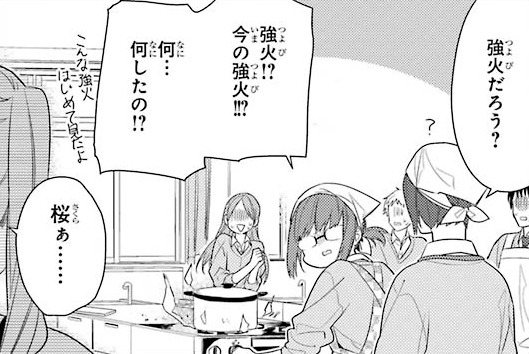
In cooking class, Sakura is in the same group as Remi and Sengoku, who can barely cook. Sakura told Sengoku to heat up the curry. He turned the burner up until flames roared around the pot, and Sakura asked what kind of heat he thought he was using.
- 仙石:
- 「強火だろう?」
- “It's high heat, isn't it?”
- 桜:
- 「強火!?今の強火!!?」
- “High heat?! You call that high heat?!”
- Literal: “High heat?! That just now was high heat?!”
- 「何…何したの!?」
- “What… What did you do?!”
- 「こんな強火はじめて見たよ」
- “I've never seen heat that high.”
- 綾崎:
- 「桜ぁ……」
- “Sakura…”
Key Points
1強火 = high heat
- Recipes give heat in a set of words built on 火, the burner’s flame: 強火 high, 中火 medium, 弱火 low, and とろ火 very low. After another word, 火 is read び.
- They take で for how you cook something, as in 強火で炒める, “stir-fry over high heat”, and に for changing the setting, as in 弱火にする, “turn it down to low”.
- 強火 still means a flame kept under the pot. A recipe would never call for fire that climbs up its sides, so Sakura refuses to accept Sengoku’s word for it.
2今の強火 = that was high heat?
- 今の points to something that just happened, “the one just now”. 今の強火!!? asks whether what everyone just saw really counts as high heat.
- Sakura repeats his word twice, first in disbelief, then pointing back at the fire. The extra punctuation shows her voice climbing.
3強火だろう? = it’s high heat, isn’t it?
- だろう with a rising tone asks the listener to agree with something the speaker treats as obvious. Sengoku answers Sakura’s question as if she should know already.
4何したの!? = what did you do?!
- の at the end of a question asks for an explanation of what the speaker can see. Sakura sees the fire and wants to know how Sengoku caused it.
5こんな強火はじめて見た = I’ve never seen heat like this
- はじめて見た means “I saw it for the first time”, so English says “I’ve never seen”. こんな puts the fire in front of them as the thing that’s new.
Vocabulary
強火 (High heat)
強火 is a strong flame on a stove, the highest of the usual heat settings in cooking.
See Also
- Vocabulary: Collocations for cooking
- Grammar: Presuming with 〜だろう and 〜でしょう
- Grammar: Reasoning with 〜のだ
- Kanji: Strength and force with 強
ホリミヤ © its respective creators. It is used here for educational commentary.