Sent with a gift from mom with 〜される
Grammar Explanation: Being made to do with 〜させられる
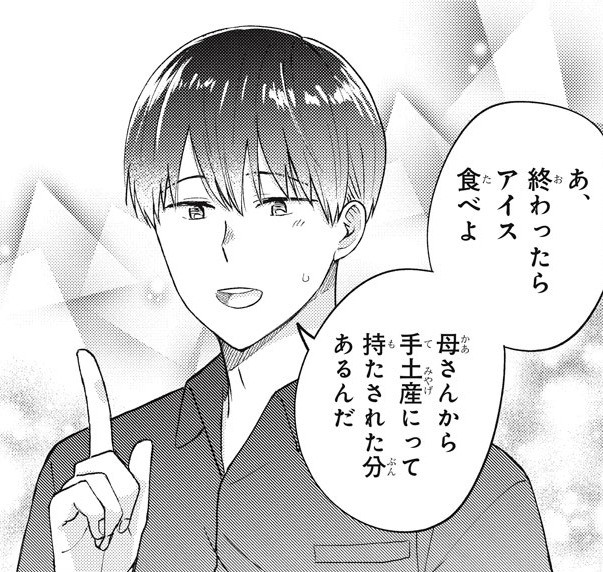
With summer vacation almost over, Makoto still hasn’t finished her homework. Tsukasa comes over to cheer her on through her last assignment, but she soon slumps over the table, worn out.
- 司:
- 「あ、終わったらアイス食べよ」
- “Oh, let's have ice cream when you're done.”
- 「母さんから手土産にって持たされた分あるんだ」
- “My mom sent me over with some as a gift.”
- Literal: “There's a portion I was made to carry from my mom, saying 'as a gift'.”
Key Points
- 持たせる often means “give someone something to take along”. Its short causative-receptive, 持たされる, is “be sent off with” or “be given something to take”.
- There’s little sense of being forced. 持たされた just says the idea was his mom’s, not his.
- The person behind 〜させられる usually takes に. With verbs where something passes from one person to another, such as 持たされる, から works too, since the ice cream came from his mom.
- 手土産 is a small gift you bring when visiting someone’s home. に here means “as”, and って quotes his mom: she said “as a gift” when she handed it over.
- 分 is “portion” or “share”. 持たされた分 is “the share I was sent with”, and が after it is dropped in casual speech.
- あるんだ uses んだ to explain. Tsukasa is telling Makoto why he can offer ice cream.
- 食べよ is a casual, shortened 食べよう, “let’s eat”.
Vocabulary
あ (Ah)
あ is a short sound people make when they suddenly notice or remember something, or when they want someone’s attention.
終わる (To end)
終わる is for something to come to an end. After a verb stem, it means to finish doing it.
アイス (Ice cream)
アイス is ice cream or another frozen dessert, such as a popsicle.
食べる (To eat)
食べる is to put food in your mouth, chew, and swallow it.
母さん (Mom)
母さん is a familiar word for mother. People call their own mother this.
手土産 (Gift for a host)
手土産 is a small gift you bring when visiting someone’s home.
持つ (To hold)
持つ is to hold or carry something, or to have it.
分 (Share)
分 is a share or portion, as in 俺の分, “my share”. It also means one’s place or status.
ある (To exist)
ある is to exist or be in a place, for things and plants rather than people or animals. It also means to have something, or for an event to take place.
See Also
- Grammar: Being made to do with 〜させられる
- Grammar: Volitional with 〜う・〜よう
- Grammar: Reasoning with 〜のだ
- Kanji: Dividing and portions with 分
- Kanji: Eating and food with 食
- Kanji: Hands and skill with 手