Sharing the harvest with 採れる
Vocabulary Explanation: Taking, catching, and photographing with とる
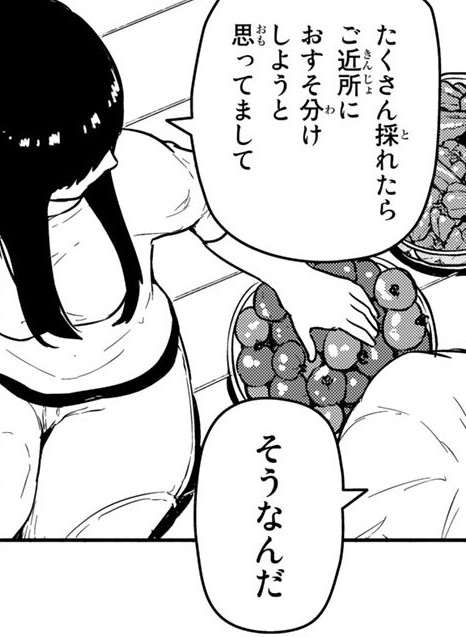
Makoto grew tomatoes, peppers, and corn from seed in the family’s garden, and the harvest has come in. After everyone tastes the vegetables fresh off the plants, the rest sits in baskets on the porch. Everyone is amazed at how much they picked, and it’s only part of the crop.
- 真琴:
- 「たくさん採れたらご近所におすそ分けしようと思ってまして」
- “I was thinking that if we got a big harvest, I'd share some with the neighbors.”
- Literal: “If a lot gets harvested, I was thinking of sharing some with the neighborhood.”
- 茜:
- 「そうなんだ」
- “Oh, I see.”
Key Points
- 採れる is the intransitive partner of 採る, “gather”. The crop is the subject: 野菜が採れる, “the vegetables come in”. Makoto leaves the vegetables unsaid, and たくさん says how much comes in.
- The same form is also the potential of 採る, “can pick”. Here the two readings meet. “If we can pick a lot” and “if a lot comes in” both describe a big harvest.
- Makoto writes 採, the kanji of 採集, “collecting”, because these are vegetables picked off the plant. 取 would be correct too, but 採 shows this is a harvest. A few pages earlier, the peppers were called 採れたて, “freshly picked”, with the same kanji.
- 〜たら makes a condition. The plan to share depends on how big the harvest turned out.
- おすそ分け is passing on part of something you received or made, usually to neighbors or friends. Homegrown vegetables are a classic case.
- 〜しようと思う is “think of doing”. 思ってまして is the polite 思っていまして with the い dropped. It stops on the て-form and trails off, which softens her explanation instead of ending it with a flat statement.
Vocabulary
| Word | English | Meaning |
|---|---|---|
| たくさん | A lot | たくさん describes a large amount or number of something. |
| 採れる | To be harvested | 採れる is for a crop, plant, or other natural product to be gathered or harvested. It also means being able to gather it. |
| 近所 | Neighborhood | 近所 means the neighborhood or an area nearby. |
| おすそ分け | Sharing a portion | おすそ分け is passing on part of something you were given or made, such as a gift of fruit or homegrown vegetables, to neighbors or friends. It is also written お裾分け. |
| する | To do | する is to do or perform something. It also turns many nouns into verbs, as in 勉強する. |
| 思う | Think | 思う is to have a thought, feeling, belief, or hope about something. |
| そう | So | そう means “like that” or “that way”. Said alone, it agrees: “right”. After a verb stem or adjective, it means something looks or seems a certain way. |
See Also
- Vocabulary: Taking, catching, and photographing with とる
- Grammar: If and when with 〜たら
- Grammar: Thinking of doing with 〜ようと思う
- Grammar: Polite style with です and ます
- Kanji: Dividing and portions with 分