Sharpening the restaurant's knives with 包丁研ぎ
Vocabulary Explanation: Collocations for cooking
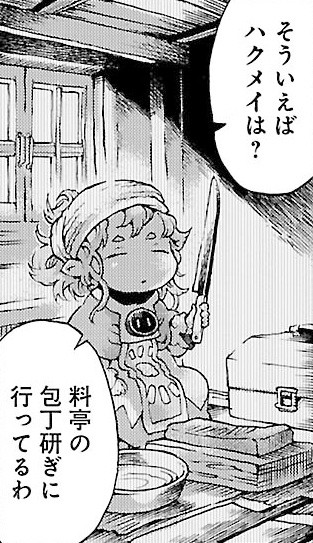
Konju drops by Hakumei and Mikochi’s new house with a housewarming gift of herbal tea. She talks with Mikochi for a bit.
- コンジュ:
- 「そういえばハクメイは?」
- “Come to think of it, where's Hakumei?”
- ミコチ:
- 「料亭の包丁研ぎに行ってるわ」
- “She's out sharpening knives for a restaurant.”
- Literal: “She has gone to a ryōtei's knife sharpening.”
Key Points
1包丁研ぎ = knife sharpening
- 研ぐ is the verb for sharpening a blade on a whetstone, and 包丁を研ぐ is the usual way to say “sharpen a kitchen knife”. The panel shows Hakumei with her knife and whetstone.
- Put a noun before a verb stem and the pair becomes one compound noun with no を: 包丁を研ぐ becomes 包丁研ぎ, the same way 皿を洗う becomes 皿洗い, dishwashing. The compound can name the work, the tool, or the person who does it. Here it’s the work.
- The same 研ぐ goes with rice: 米を研ぐ means to wash rice by rubbing the grains together in water. Learn each use with its noun.
2料亭の
- A 料亭 is a traditional, high-end Japanese restaurant. の ties the job to that restaurant, so the knives belong to its kitchen.
3〜に行ってる = has gone to do ~
- に行く after an action noun or verb stem gives the reason for going: 買い物に行く, to go shopping. Here the purpose is 包丁研ぎ.
- 行ってる is the casual contraction of 行っている. With 行く, ている describes the state after leaving, so it means “has gone and is there now”, not “is on the way”. Hakumei is out of the house.
- The わ at the end softens Mikochi’s statement. It’s part of her ordinary speaking style.
4そういえば〜は? = by the way, what about ~?
- そういえば brings up something the conversation just reminded the speaker of. Konju’s question stops at は, leaving out どこにいるの or a similar ending. A rising tone on 〜は? is enough to ask where someone is or how something stands.
Vocabulary
そういえば (Come to think of it)
そういえば brings up something the speaker has just been reminded of, like “come to think of it” or “speaking of which”. It often opens a change of subject.
包丁 (Kitchen knife)
包丁 is the knife used for cooking. Kinds are named by what they cut, such as a 出刃包丁 for fish.
研ぐ (To sharpen)
研ぐ is to sharpen a blade by rubbing it on a whetstone, as in 包丁を研ぐ. With rice, it means to wash the grains by rubbing them together in water: 米を研ぐ.
行く (To go)
行く means to go or move toward a place away from the speaker.
See Also
- Vocabulary: Collocations for cooking
- Grammar: Going to for a purpose with 〜に行く
- Grammar: Ongoing actions and resulting states with 〜ている
- Grammar: How casual contractions work
- Grammar: Marking the topic with は and も
- Kanji: Going and carrying out with 行
ハクメイとミコチ © its respective creators. It is used here for educational commentary.