Short-handed student council with 〜たばかり
Grammar Explanation: Just happened with 〜た+ばかり
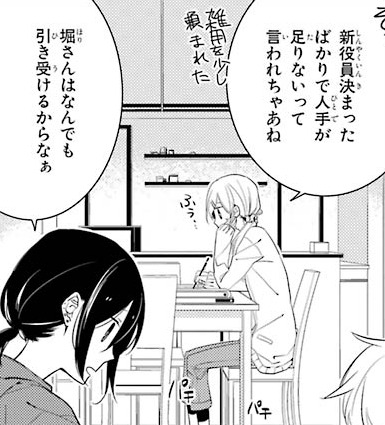
At Hori’s house, Miyamura is playing a board game with her little brother Souta while Hori works through a stack of papers at the kitchen table. Miyamura asks whether she’s helping out the student council.
- 堀:
- 「新役員決まったばかりで人手が足りないって言われちゃあね」
- “When they tell me the new officers were only just chosen and they're short on help, what can I do?”
- Literal: “If I'm told that the new officers were only just decided, so they don't have enough hands, well...”
- 「雑用を少し頼まれた」
- “Asked to do a few odd jobs.”
- 宮村:
- 「堀さんはなんでも引き受けるからなぁ」
- “You do take on anything you're asked.”
Key Points
- The た-form 決まった plus ばかり says the new officers were picked not long ago.
- The particle が is dropped after 新役員, as is common in casual speech. In full it is 新役員が決まったばかり.
- で, the て-form of だ, links the recent event to its result: the officers are new, so 人手が足りない, “they’re short on help”.
- 人手 is “hands” in the sense of workers, and 足りない means “not enough”.
- 言われる is the receptive of 言う, “to be told”. って quotes what she was told.
- ちゃあ is ては contracted and drawn out. 〜ては sets up a situation that leads somewhere hard to avoid, here “if they put it like that”.
- Hori doesn’t finish the sentence. The missing part is that she couldn’t say no, and ね asks Miyamura to see it her way.
- なんでも means “anything”, and 引き受ける means “to take on” a task or request.
- Ending on から gives the reason without stating the result. Miyamura is saying her habit of taking on everything explains why she’s stuck with this work. なぁ makes it a musing remark.
Vocabulary
新 (New)
新 is a prefix meaning new or newly appointed, as in 新役員, “new officers”, or 新学期, “new school term”.
決まる (To be decided)
決まる means for something to be decided, settled, or fixed, such as a plan, a rule, or who will fill a role. It can also mean for a move or outfit to look sharp.
人手 (Help, workers)
人手 means people to do work, as in 人手が足りない, “short-handed”. It can also mean someone else’s hands or help.
足りる (To be enough)
足りる means to be enough or sufficient. It most often appears as 足りない, “not enough”, “short of”.
言う (To say)
言う means to say or tell. It can also mean to call something by a particular name.
雑用 (Odd jobs)
雑用 means chores or odd jobs, the small miscellaneous tasks that need doing.
少し (A little)
少し describes a small amount or degree.
頼む (To ask)
頼む is to ask someone to do something, or to order something.
なんでも (Anything)
なんでも means anything or everything, whatever it is. It is the kana spelling of 何でも.
引き受ける (To take on)
引き受ける means to agree to take on a task, request, or responsibility, as in 仕事を引き受ける, “to take on a job”.
See Also
- Grammar: Just happened with 〜た+ばかり
- Grammar: Quoting and reporting with と and って
- Grammar: Receptive verbs with 〜れる
- Grammar: How casual contractions work
- Grammar: Because with 〜から
- Vocabulary: Something, nothing, and anything with question words
- Kanji: Hands and skill with 手
- Kanji: Members and personnel with 員
- Kanji: People and persons with 人