Singing one song after another with 連続
Kanji Explanation: Continuation and connection with 続
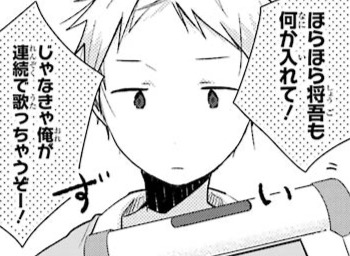
To distract himself from things going on with Fujimiya, Hase goes to karaoke, bringing Shougo with him.
- 長谷:
- 「ほらほら翔吾も何か入れて!」
- “Come on, come on, Shougo! Put something in, too!”
- 「じゃなきゃ俺が連続で歌っちゃうぞー!」
- “Otherwise, I'll just keep singing one after another!”
- Literal: “If not, I'll end up singing continuously!”
Key Points
1連続で = “continuously”
- Here 連続 means Hase would keep singing songs with no break.
- The particle で marks the manner or condition, so 連続で歌う is “sing continuously” or “sing one song after another”.
2Casual contraction: 歌っちゃう
- 歌っちゃう is a spoken contraction of 歌ってしまう.
3じゃなきゃ = “if not”
- じゃなきゃ is a casual shortening of じゃなければ.
- It connects directly to the previous line.
4Sentence ending nuance: ぞー
- The ending ぞー makes the line sound emphatic and teasing, like Hase is half-warning and half-joking.
Vocabulary
何か (Something)
何か means something or anything. It can also introduce an uncertain question, as in “Is something wrong?”
俺 (I)
俺 means “I” or “me”. Men commonly use it in casual speech, and it sounds rougher and more masculine than 私 or 僕.
連続 (Continuation)
連続 means a sequence or continuation without interruption.
See Also
- Kanji: Continuation and connection with 続
- Grammar: Doing completely or ending up doing with 〜てしまう and 〜ちゃう
- Future entry: Hypothetical condition with 〜ば
- Future entry: Rough declarations with ぞ and ぜ
- Grammar: Marking the topic with は and も
- Kanji: Linking and succession with 連
一週間フレンズ。 © its respective creators. It is used here for educational commentary.