Skilled clock maker with 職人
Vocabulary Explanation: Skilled artisan with 職人
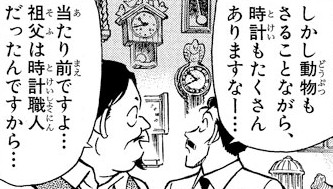
Having received a letter requesting help solving a mystery, Kogoro finds himself in a house filled with animal designs everywhere, including the doors, the chairs, and the plates. His attention turns to the clocks covering the walls.
- 小五郎:
- 「しかし動物もさることながら、時計もたくさんありますなー...」
- “But aside from the animals, there are also a lot of clocks, huh...”
- 男:
- 「当たり前ですよ... 祖父は時計職人だったんですから...」
- “Of course there are... Grandfather was a clock maker, after all...”
Key Points
1時計職人 = “clockmaker” / “clock artisan”
- Here 職人 means a skilled craftsperson, not just someone with a job; it emphasizes trained hands-on workmanship.
- With 時計 in front, 時計職人 becomes a craftsperson who makes or works on clocks, which is why maker fits in the translation.
2Compound noun pattern: 時計 + 職人
- There is no particle between the two nouns; 時計 directly specifies what kind of artisan he was.
- This same pattern is very common in Japanese: [thing] + [person/role] = a person who works with that thing.
3だったんですから = explanatory reason
- だった is the past form of です / だ, and んです adds an explanatory tone: you see / the reason is that….
- から gives the reason, so 祖父は時計職人だったんですから means it’s because Grandfather was a clockmaker.
- In context, he is explaining why the house has so many clocks.
4当たり前ですよ = “Of course”
- This replies directly to Kogoro’s observation about all the clocks and treats it as something completely expected.
- The polite ですよ adds a lightly emphatic, matter-of-fact tone: Of course there are.
Vocabulary
動物 (Animal)
動物 means an animal. In everyday use, it usually means a nonhuman creature.
時計 (Clock)
時計 means a clock, watch, or other device that measures and displays time.
祖父 (Grandfather)
祖父 is the standard formal word for one’s grandfather.
職人 (Craftsperson)
職人 means a skilled craftsperson or artisan trained in a manual trade.
See Also
- Vocabulary: Skilled artisan with 職人
- Future entry: Past tense with 〜た・〜だ
- Grammar: Reasoning with 〜のだ
- Grammar: Marking the topic with は and も
- Kanji: Counting and planning with 計
- Kanji: Motion and activation with 動
- Kanji: People and persons with 人
- Kanji: Things and kinds with 物
- Kanji: Time and occasions with 時
名探偵コナン © its respective creators. It is used here for educational commentary.