Skilled mirror maker with 職人
Vocabulary Explanation: Skilled artisan with 職人
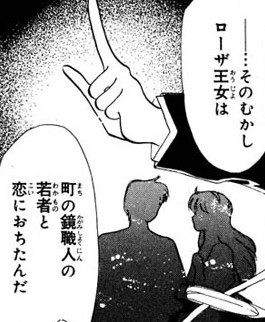
Following the theft of the Mirror of Queen Rosa, Sawatari writes an article for the school paper accusing Saint Tail. As Asuka Jr. demands proof from Sawatari, a notification appears from Saint Tail, announcing her intent to steal the stolen mirror. Later, Asuka Jr. goes to Sawatari to learn about the mirror’s backstory.
- 佐渡:
- 「そのむかしローザ王女は街の鏡職人の若者と恋におちたんだ」
- “Long ago, Princess Rosa fell in love with a young mirror maker from the town.”
Key Points
- 職人 does not just mean “worker”; it means a trained artisan with a specialized craft.
- 鏡職人 means a person whose trade is making mirrors, so mirror maker is the most natural gloss in this scene.
- The sentence describes one person: a young man who is a mirror artisan from the town.
- The core statement is ローザ王女は … 若者と 恋におちた.
- そのむかし means long ago and immediately gives the line a fairy-tale or legend-like opening.
- The ending おちたんだ is おちた + のだ in casual speech. Here it adds an explanatory, narrative tone, like the speaker is telling the backstory.
Vocabulary
| Word | English | Meaning |
|---|---|---|
| その | That | その points to something near the listener or to something just mentioned. Said alone, it fills a pause, like “um”. |
| むかし | Long ago | むかし is the distant past. その昔 means “long, long ago”. It is also written 昔. |
| 王女 | Princess | 王女 means a princess, especially the daughter of a king. |
| 街 | Town | 街 is a town or city, especially the streets of a busy area. |
| 鏡 | Mirror | 鏡 is a mirror. |
| 職人 | Craftsperson | 職人 means a skilled craftsperson or artisan trained in a manual trade. |
| 若者 | Young person | 若者 means a young person or young people as a group. |
| 恋 | Love | 恋 is romantic love. 恋に落ちる means to fall in love. |
| おちる | To fall | おちる is to drop from a higher place. It also appears in 恋におちる, to fall in love. It is the kana spelling of 落ちる. |
See Also
- Vocabulary: Skilled artisan with 職人
- Grammar: Past tense with 〜た・〜だ
- Grammar: The copula だ
- Grammar: Marking the topic with は and も
- Kanji: People and persons with 人
- Kanji: Reflection and optics with 鏡
- Kanji: Women and femininity with 女