So that was a knife sharpener with 包丁研ぎ
Vocabulary Explanation: Collocations for cooking
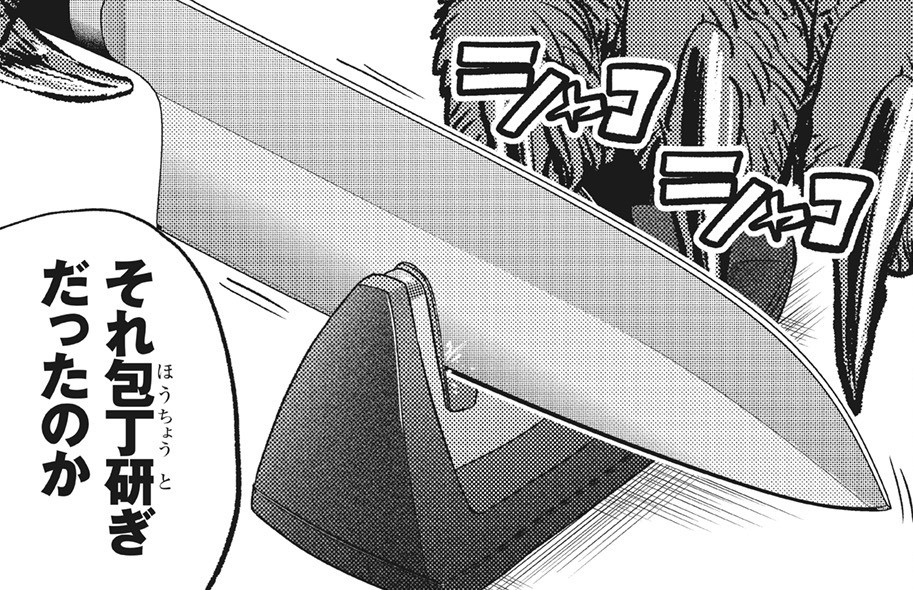
Kumada has long wondered how the bear pays for all the gadgets it keeps ordering online, and he confronts it. Another delivery arrives, and the bear indicates that everything in the box is for him. Kumada picks up a small object he can’t identify and asks what it is. The bear takes a kitchen knife and runs it through the object.
- 熊田:
- 「それ包丁研ぎだったのか」
- “So that was a knife sharpener.”
Key Points
1包丁研ぎ = a knife sharpener
- 包丁研ぎ comes from the collocation 包丁を研ぐ, to sharpen a kitchen knife. The verb’s stem 研ぎ works as a noun, and the を drops when the two words join into one.
- The compound can name the job of sharpening knives or the tool that does it. Here it is the tool, the small triangular sharpener the knife runs through.
- Many compounds are built this way, object first and then the verb stem: 皿洗い, dishwashing, from 皿を洗う.
2だったのか = so it was
- だった is the past form of だ. The gadget was a knife sharpener before Kumada knew it, and the past tense marks what he has just found out.
- のか turns the statement into a realization: “oh, so that’s what it was”. It is blunt and casual, and it’s mostly men who say it. A softer version is だったんだ.
3それ = that thing
- それ points to something near the listener. The gadget is in the bear’s paws, so Kumada calls it それ.
- The topic particle is left out, as often happens in casual speech: それ(は)包丁研ぎだったのか.
Vocabulary
それ (That)
それ points to something near the listener, or to something just mentioned.
包丁 (Kitchen knife)
包丁 is the knife used for cooking. Kinds are named by what they cut, such as a 出刃包丁 for fish.
研ぎ (Sharpening)
研ぎ is the act of sharpening a blade on a whetstone. After another noun, it can name the tool that does it, as in 包丁研ぎ, a knife sharpener.
See Also
- Vocabulary: Collocations for cooking
- Grammar: Past tense with 〜た・〜だ
- Grammar: Reasoning with 〜のだ
くまぐらし © its respective creators. It is used here for educational commentary.