Something to talk about regarding Fujimiya with 〜のことで
Grammar Explanation: Referring to a person with 〜のこと
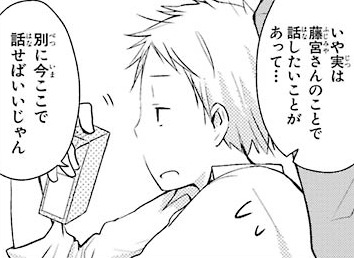
Fujimiya’s memories of her friends reset every week, and Hase has been the only one who knows. With her permission, he decides to tell his friend Shogo, who he trusts not to spread it around, and asks Shogo to join them for lunch on the roof. Shogo asks why.
- 長谷:
- 「いや 実は藤宮さんのことで話したいことがあって…」
- “Well, actually, there's something I want to talk to you about. It's about Fujimiya...”
- Literal: “Well, actually, there's something I want to talk about concerning Fujimiya, so...”
- 桐生:
- 「別に今ここで話せばいいじゃん」
- “So just tell me here.”
Key Points
- のことで gives the matter behind a talk, advice, or a quarrel: “about” or “concerning”. It can be swapped for について.
- 話したいこと is “something I want to talk about”, and がある says he has it.
- Ending on the て-form あって leaves the request unsaid: “so (come with me)”.
- 〜ばいい means “you can just…” じゃん is a casual じゃないか: “Can’t you just tell me here?”
- 別に here means “there’s no particular need” to go anywhere.
Vocabulary
いや (false)
いや is used to deny something or to hesitate, like “no” or “well…”. It also describes something unpleasant or unwanted, often written 嫌.
実は (Actually)
実は introduces the truth, often something the listener did not know: “to tell the truth”.
こと (Thing)
こと is an abstract thing, matter, or fact, as opposed to a physical object. It also turns a verb phrase into a noun, as in 見たことがある. It is also written 事.
話す (To talk)
話す is to talk or speak. It also means to tell someone something.
ある (To exist)
ある is to exist or be in a place, for things and plants rather than people or animals. It also means to have something, or for an event to take place.
別に (Not particularly)
別に means “not particularly” when used with a negative. Said alone, it means “nothing in particular” or “it doesn’t matter”.
今 (Now)
今 is the present moment, or these days.
ここ (Here)
ここ is the place where the speaker is.
いい (Good)
いい describes something good, nice, or fine. It can also mean “okay” or “that’s enough”. Its other forms come from よい, as in よくない and よかった.
See Also
- Grammar: Referring to a person with 〜のこと
- Grammar: Want to say or do something with 〜たい+ことがある
- Kanji: Now and the present with 今