Sometimes pretending to be someone else with 〜ことがある
Grammar Explanation: Sometimes with 〜ことがある
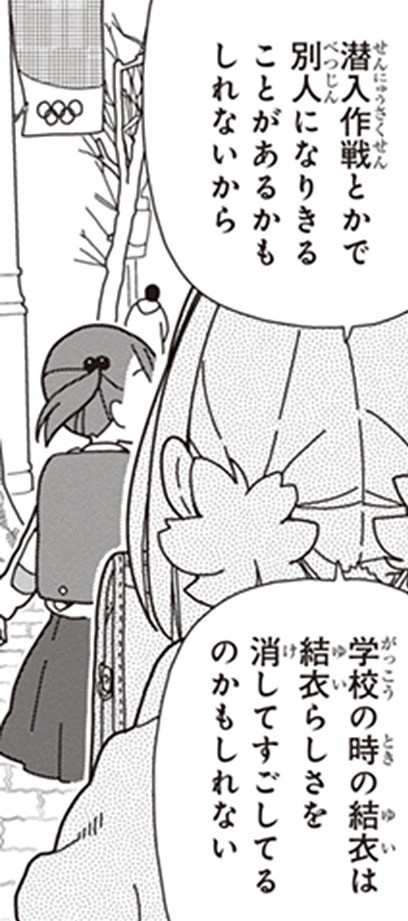
Sacchan and Kotoha notice Yui walking with a couple of her friends from school. The two decide to sneak and follow after them. Sacchan notices Yui doesn’t act quite the same with these friends as she does with Sacchan and Kotoha.
- さっちゃん:
- 「潜入作戦とかで別人になりきることがあるかもしれないから」
- “Maybe it's because she's in an undercover operation or something that she sometimes pretends to be a different person....”
- Literal: “Because maybe, during an infiltration mission or something, there are times when she fully becomes a different person...”
- 「学校の時の結衣は結衣らしさを消してすごしてるのかもしれない」
- “...that Yui at school might be trying to hide her true self.”
- Literal: “Maybe Yui when she's at school spends her time erasing her Yui-ness.”
Key Points
- Here 別人になりきることがある means “there are times when she fully acts like a different person”.
- It describes something that happens on some occasions, not a one-time event happening right now.
- 「なりきる」 is stronger than just “become”. It means to thoroughly take on a role or persona.
- The idea is “Maybe it’s because she sometimes has to pretend to be someone else…”
- 「から」 links that imagined reason to the following speculation about Yui hiding her usual self at school.
- 「ことがあるかもしれない」 means even the “sometimes does that” part is only a guess.
- The next line ends with のかもしれない, so Sacchan is building a theory rather than stating a fact.
Vocabulary
| Word | English | Meaning |
|---|---|---|
| 潜入 | Infiltration | 潜入 means secretly entering or infiltrating a place or organization, often for spying or investigation. |
| 作戦 | Strategy | 作戦 means a plan for carrying out an operation. It often refers to military strategy, but it also works for everyday plans and schemes. |
| 別人 | Different person | 別人 means a different person. Figuratively, it can describe someone whose appearance or behavior has changed beyond recognition. |
| なりきる | To fully become | なりきる is to become someone or something completely, or to play a role so well that you seem to be it. |
| こと | Thing | こと is an abstract thing, matter, or fact, as opposed to a physical object. It also turns a verb phrase into a noun, as in 見たことがある. It is also written 事. |
| ある | To exist | ある is to exist or be in a place, for things and plants rather than people or animals. It also means to have something, or for an event to take place. |
| 学校 | School | 学校 means a school, where teachers provide organized instruction to students. |
| 時 | Time | 時 is a point or stretch of time. 〜時 means “when” or “at the time of”. |
| 消す | To erase | 消す is to erase or turn something off. It also means to hide or suppress something. |
| すごす | To spend time | すごす is to spend time or live through a period in a certain way. It is also written 過ごす. |
See Also
- Grammar: Sometimes with 〜ことがある
- Grammar: Might with 〜かもしれない
- Grammar: Negation with 〜ない
- Grammar: Marking the topic with は and も
- Kanji: Entering and putting in with 入
- Kanji: Learning and schooling with 学
- Kanji: Making and creating things with 作
- Kanji: People and persons with 人
- Kanji: Schools and checking with 校
- Kanji: Time and occasions with 時