Sorting out the carrots with 選別
Kanji Explanation: Choosing and selection with 選
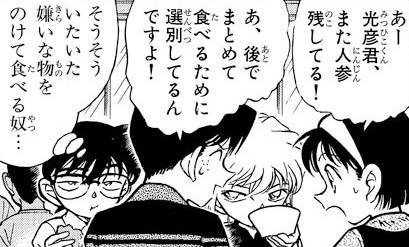
Conan sulks that he’s a high schooler stuck eating elementary school lunch. Haibara says she enjoys it, since at her school in America she ate alone in a self-service cafeteria. Conan admits that school lunch felt nostalgic to him at first.
- 歩美:
- 「あー光彦君、また人参残してる!」
- “Ah, Mitsuhiko, you're leaving your carrots again!”
- 光彦:
- 「あ、後でまとめて食べるために選別してるんですよ!」
- “Oh, I'm just sorting them out so I can eat them all at once later!”
- コナン:
- 「そうそう いたいた 嫌いな物をのけて食べる奴…」
- “Oh yeah, there was always one. The kid who pushes the food he hates aside and eats around it...”
Key Points
- 選別 combines 選, to choose, with 別, to separate. It means sorting things into groups by kind or quality.
- The word usually describes things like sorting trash or produce. Using it for pushing carrots aside makes Mitsuhiko’s excuse sound official.
- まとめて means all together or in one batch. He claims he will eat the carrots in one go.
- ために after a dictionary-form verb gives a purpose: “in order to eat them later”.
- 残してる is the casual form of 残している, “leaving food uneaten”. With また, Ayumi says he is doing it again.
- いたいた repeats いた, the past of いる. It’s a reaction of recognition, “oh yes, there was always someone like that”.
- 嫌いな物をのけて食べる奴 is a noun phrase. のける means to move something aside, so the kid eats around the food he hates.
Vocabulary
| Word | English | Meaning |
|---|---|---|
| 君 | You | 君 is a word for “you” used toward equals or people younger or of lower standing. It sounds gentle or poetic. Read くん, it is a suffix on names. |
| また | Again | また means “again” or “once more”. It also means “also”. As a goodbye, またね means “see you”. |
| 人参 | Carrot | 人参 is a carrot. It also names ginseng, the medicinal root the word first referred to. |
| 残す | To leave | 残す is to leave something behind or uneaten. |
| あ | Ah | あ is a short sound people make when they suddenly notice or remember something, or when they want someone’s attention. |
| 後 | After | 後 is the time after something, the space behind something, or what remains. |
| まとめる | To gather together | まとめる is to gather separate things into one, such as collecting papers, summing up an idea, or settling a plan. With 髪, it means to tie back or put up your hair. |
| 食べる | To eat | 食べる is to put food in your mouth, chew, and swallow it. |
| ため | For | ため is the purpose or benefit of something: 〜のため means “for the sake of” or “in order to”. It can also give a cause: “because of”. It is also written 為. |
| 選別 | Sorting | 選別 is sorting things into groups by kind or quality, or screening out the ones you want. |
| いる | To be | いる is to exist or be somewhere, for people and animals. After a て-form verb, it shows an ongoing action or a continuing state. |
| 嫌い | Disliked | 嫌い describes something a person dislikes or hates. After a noun, as in タバコ嫌い, it is read ぎらい and describes someone who can’t stand that thing. |
| 物 | Thing | 物 is a physical thing or object. |
| のける | To move aside | のける means to move something out of the way or set it aside, as when picking out food you don’t want to eat. |
| 奴 | Guy | 奴 is a rough word for a person, like “guy”. It can also mean a thing. |
See Also
- Kanji: Choosing and selection with 選
- Grammar: Purpose and cause with 〜ために
- Kanji: After and behind with 後
- Kanji: Eating and food with 食
- Kanji: People and persons with 人
- Kanji: Things and kinds with 物