Speaking through Mokona with 語りかける
Vocabulary Explanation: Words ending in 掛ける
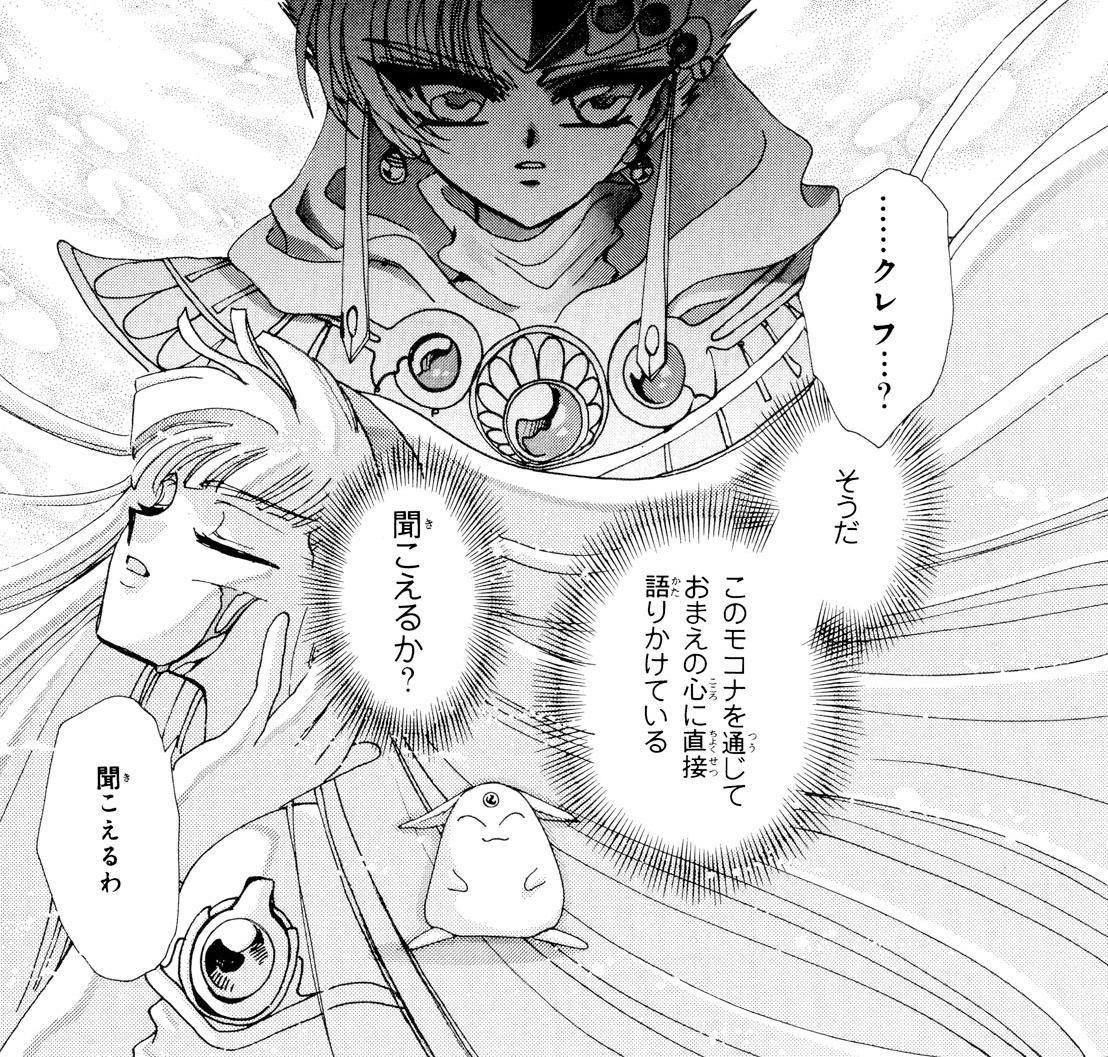
Umi lies injured while Hikaru fights the woman in black alone. Umi wishes she had learned magic from Clef, the sorcerer who is Mokona’s true master, so she could help. The jewel on Mokona’s forehead turns from red to blue, and Clef’s voice calls her name.
- 海:
- 「……クレフ…?」
- “...Clef...?”
- クレフ:
- 「そうだ」
- “That's right.”
- 「このモコナを通じておまえの心に直接語りかけている」
- “I'm speaking directly to your heart through this Mokona.”
- 「聞こえるか?」
- “Can you hear me?”
- 海:
- 「聞こえるわ」
- “I can hear you.”
Key Points
- 語る means to tell or relate. Adding かける aims the words at a listener, so 語りかける means to speak to someone or address them.
- It often appears with 心に, speaking to someone’s heart. That fits Clef reaching Umi with magic instead of his voice.
- このモコナを通じて means “through this Mokona”. 〜を通じて marks the channel or medium something passes through.
- 語りかけている describes an action in progress: Clef is speaking to her at this moment.
- 聞こえる means a sound reaches someone, “can be heard”. 聞こえるか? checks whether his words are getting through.
- Umi answers 聞こえるわ. The わ is a soft sentence ending often used by female speakers.
Vocabulary
そう (So)
そう means “like that” or “that way”. Said alone, it agrees: “right”. After a verb stem or adjective, it means something looks or seems a certain way.
この (This)
この means “this” or “these” and comes directly before a noun. It points to something near the speaker or something the speaker is referring to in the conversation.
通じる (To get through)
通じる is to get through or connect, such as a road leading somewhere or a message being understood. 〜を通じて means “through” or “by way of”.
おまえ (You)
おまえ is a casual, rough word for “you”. Men often use it toward people of equal or lower standing. It is also written お前.
心 (Heart, mind)
心 is the heart or mind, where a person’s feelings, thoughts, and will are. 心の目, “the mind’s eye”, is seeing or understanding without using your eyes.
語りかける (To speak to)
語りかける is to speak to someone directly, often earnestly or heart to heart. Eyes, music, or a scene can also be said to speak to a person.
聞こえる (To be heard)
聞こえる means a sound reaches someone’s ears, “can be heard”. 聞こえる? asks whether someone can hear you.
See Also
- Vocabulary: Words ending in 掛ける
- Grammar: Ongoing actions and resulting states with 〜ている