Special fishing line as evidence with 釣り糸
Kanji Explanation: Fishing and baiting with 釣
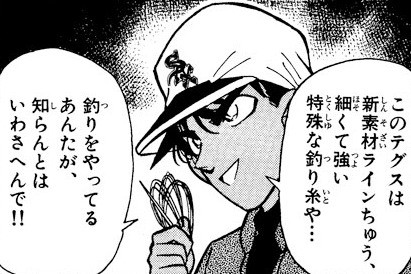
Diplomat Isao Tsujimura has been found poisoned in his study, locked from the inside with his own key in his pocket. Heiji Hattori has shown how the killer could have slipped the key into that pocket from outside the door using tape and a needle-tipped length of thread. He has named the victim’s elderly father, a retired professor who dropped by that afternoon to show off a fish he’d caught. Now he holds up the thread he found in the Japanese-style room.
- 平次:
- 「このテグスは新素材ラインちゅう、細くて強い特殊な釣り糸や…」
- “This line's a special kind of fishing line called "new-material line". Thin and strong...”
- 平次:
- 「釣りをやってるあんたが、知らんとはいわさへんで!!」
- “You fish, so don't you dare tell me you've never heard of it!!”
Key Points
- 釣り糸 is 釣り, “fishing”, plus 糸, “thread”. It’s the line you cast, the same idea as English “fishing line”.
- テグス is another word for clear fishing line, so Heiji is restating what the テグス really is: 特殊な釣り糸, a special kind of fishing line.
- The second line has 釣り on its own. 釣りをやる means to fish as a hobby, and やってる is short for やっている. Heiji ties the line to the old man’s hobby.
- ちゅう is a Kansai contraction of という, “called”. The name 新素材ライン comes before it, and the description after it, 細くて強い特殊な釣り糸, says what kind of thing has that name.
- や is the Kansai copula, the same as standard だ. 釣り糸や means 釣り糸だ.
- 知らん is 知らない, and final で works like standard よ.
- いわさへん is Kansai for いわせない, “I won’t let you say”. いわす is a causative form of いう, and へん makes it negative.
- とは marks the words Heiji won’t let him say: 知らん, “I don’t know”. Put together, it means “I won’t let you claim you don’t know it.”
- The line heads off a denial before the old man can make one. Heiji uses it to back him into a corner.
Vocabulary
| Word | English | Meaning |
|---|---|---|
| テグス | Nylon line | テグス is thin, clear nylon line, used as fishing line and for stringing beads. |
| 新素材 | New material | 新素材 is a newly developed material, often a high-tech one. |
| ライン | Line | ライン is a line, such as a drawn line, a boundary, or a length of fishing line. |
| 細い | Thin | 細い describes something narrow or slim, like a thread, a wire, or a person’s arm. |
| 強い | Strong | 強い describes superior strength or skill, physical or mental resilience, or an extreme degree or level of something. |
| 釣り糸 | Fishing line | 釣り糸 is fishing line, the line used with a fishing rod or hook. |
| 釣り | Fishing | 釣り is fishing with a rod, line, and hook. In a shop, 釣り, often お釣り, is also the change you get back after paying. |
| やる | To do | やる is a casual word for “to do”. It also means to give something to someone of lower standing, or to animals and plants. |
| あんた | You | あんた is a casual, blunt word for “you”. Between close people it sounds familiar, but toward others it can sound rude. |
| 知る | To know | 知る means to learn or come to know a fact or person. In the form 知っている, it describes already knowing. |
| いう | To say | いう is to put something into words. It is the kana spelling of 言う and appears in phrases like という, which introduces a name or a quoted idea. |
See Also
- Kanji: Fishing and baiting with 釣
- Grammar: Grammar in the Kansai dialect
- Grammar: Making and letting with 〜せる・〜させる
- Grammar: The copula だ
- Grammar: Quoting and reporting with と and って
- Kanji: Strength and force with 強