Staying with relatives with 〜先
Vocabulary Explanation: Place where something is done with 〜先
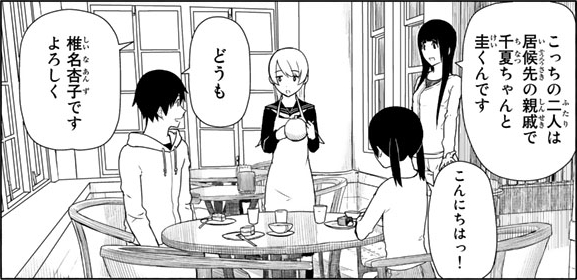
Makoto introduces Chinatsu and Kei to Anzu while the group is meeting one another.
- 真琴:
- 「こっちの二人は居候先の親戚で千夏ちゃんと圭くんです」
- “These two are the relatives I'm staying with, Chinatsu-chan and Kei-kun.”
- 千夏:
- 「こんにちはっ!」
- “Hello!”
- 圭くん:
- 「どうも」
- “Hi.”
- 杏子:
- 「椎名杏子です よろしく」
- “I'm Shiina Anzu. Nice to meet you.”
Key Points
1居候先 = “the place where someone is staying”
- 〜先 marks the place where something is done, so 居候先 means the home or household where someone is lodging.
- 居候 adds the nuance of staying at someone else’s place and depending on their hospitality, not just staying there neutrally.
2居候先の親戚 = “the relatives I’m staying with”
- The の links 居候先 to 親戚, literally: the relatives of the place/household where I’m lodging.
- In English, that becomes the relatives I’m staying with rather than a stiff literal phrasing like the relatives of my lodging place.
3Casual pointing word: こっち
- こっち literally means this way / this side, but in conversation it often works like these two here when introducing nearby people.
- ちゃん is an affectionate, informal suffix attached to names, used mainly for children, close friends, and family members.
- 君 is an honorific suffix used after names, typically for boys or men. It’s commonly used by teachers addressing male students, by friends among young people, or by superiors addressing junior colleagues, and can also be used for girls in childhood or casual contexts.
Vocabulary
二人 (Two people)
二人 means two people.
居候 (Live-in dependent)
居候 means a nonpaying lodger or freeloader who depends on someone else’s hospitality.
親戚 (Relative)
親戚 means a relative or member of one’s extended family.
See Also
- Vocabulary: Place where something is done with 〜先
- Grammar: Marking the topic with は and も
- Kanji: People and persons with 人
ふらいんぐうぃっち © its respective creators. It is used here for educational commentary.