Stewing over it alone with 悶々
Kanji Explanation: Anguish and writhing with 悶
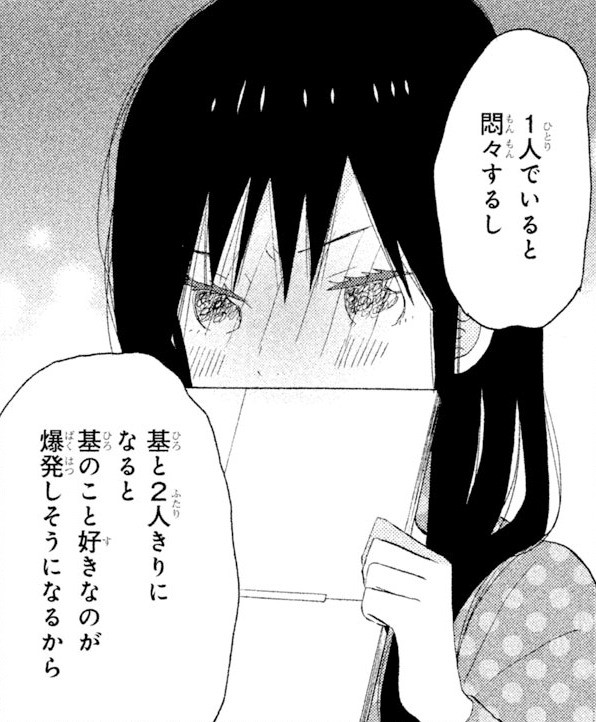
Mao has feelings for Hiro, whose younger brother Daiki has just moved back into the house. That evening she follows Daiki into his room with a notebook, saying she wants to study together. Daiki calls it an excuse and asks what happened between her and Hiro. She insists nothing happened, then admits there is something.
- 真魚:
- 「1人でいると悶々するし」
- “When I'm alone, I just stew over it...”
- 「基と2人きりになると基のこと好きなのが爆発しそうになるから」
- “...and when I'm alone with Hiro, it feels like my feelings for him are about to burst out.”
Key Points
- 悶々 describes stewing over a worry or longing you can’t settle or say out loud. The kanji 悶 means anguish, and repeating it suggests the feeling going around and around.
- It often describes lovesick fretting, as it does here. Mao can’t tell Hiro how she feels, so alone she just dwells on it.
- The standard form is 悶々とする. Mao drops the と and says 悶々する, which happens in casual speech.
- Both clauses use と for a natural result. Whenever the first thing happens, the second follows.
- 1人でいる means being on your own. 2人きり means just the two of them, with nobody else around.
- Mao sets the two situations side by side. Alone she stews. Alone with Hiro she feels close to bursting. Neither one works for her.
- し after 悶々する offers one reason and suggests there are more.
- The second line ends in から, “because”. The thing these reasons explain goes unsaid. She is explaining why she came to Daiki’s room instead of staying alone.
- 基のこと好き is a common way to say “like Hiro”. Adding のこと puts the focus on the person as a whole. The particle を is left out, as it often is in speech.
- な links the na-adjective 好き to the nominalizer の, turning “liking Hiro” into the subject of the next verb.
- 爆発しそうになる means “to be on the verge of exploding”. 〜そうになる describes something that almost happens.
Vocabulary
| Word | English | Meaning |
|---|---|---|
| いる | To be | いる is to exist or be somewhere, for people and animals. After a て-form verb, it shows an ongoing action or a continuing state. |
| 悶々 | Brooding | 悶々 means stewing over a worry you can’t resolve or let out. It usually appears as 悶々とする, often for lovesick fretting or a doubt that won’t go away. |
| する | To do | する is to do or perform something. It also turns many nouns into verbs, as in 勉強する. |
| こと | Thing | こと is an abstract thing, matter, or fact, as opposed to a physical object. It also turns a verb phrase into a noun, as in 見たことがある. It is also written 事. |
| 好き | Liked | 好き describes something you like or someone you love. |
| 爆発 | Explosion | 爆発 is an explosion. It also means a sudden outburst, such as of anger, or a sudden boom in popularity. |
| なる | To become | なる is to change into a different state or become something. It also means something turns out a certain way. It is also written 成る. |
See Also
- Kanji: Anguish and writhing with 悶
- Grammar: Natural result with 〜と
- Grammar: Referring to a person with 〜のこと
- Grammar: Looking like with 〜そうだ
- Grammar: Because with 〜から
- Kanji: Launching and arising with 発