Stop joking with 〜たまえ
Grammar Explanation: Commanding with 〜たまえ
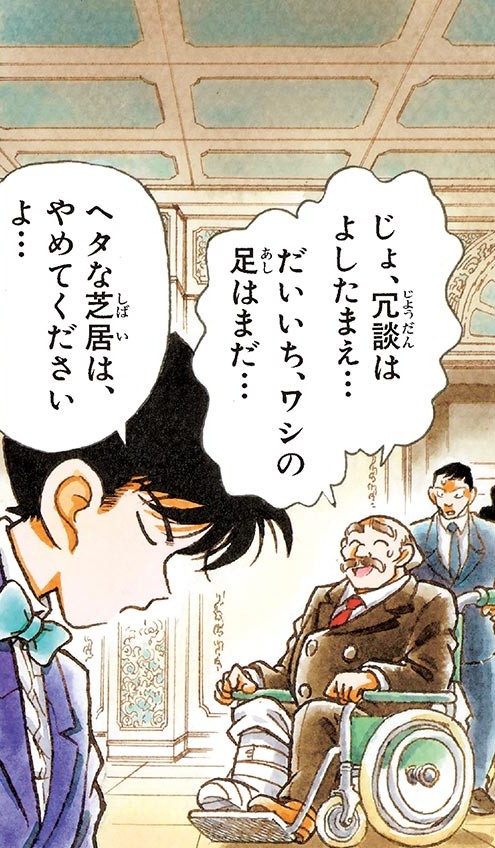
Assisting the police with a murder investigation, Shin’ichi explains how the culprit was able to move without a trace by going out a window and scaling the wall to the next window up. The victim’s husband demands to know who killed his wife, only for Shin’ichi to accuse him.
- 御主人:
- 「じょ、冗談はよしたまえ… だいいち、ワシの足はまだ…」
- “S-stop joking around.... First of all, my leg is still...”
- 新一:
- 「ヘタな芝居は、やめてくださいよ…」
- “Please stop with the lousy acting...”
Key Points
よしたまえ = “stop it” as a superior-sounding command
よしたまえ is よす “to stop (doing)” plus 〜たまえ, an imperative ending that sounds formal here.
冗談はよしたまえ
冗談は marks “joking” as the thing he wants stopped.
じょ、 shows panic before 冗談
The broken じょ is the start of 冗談, showing he stumbles before getting the word out.
だいいち introduces his first excuse
だいいち means “first” or “above all” and signals that he is about to give a reason Shin’ichi’s accusation cannot be right.
ワシの足はまだ… leaves the sentence unfinished: he is relying on the listener to infer “my leg is still not healed”.