Strange behavior with 異様
Kanji Explanation: Difference and strangeness with 異
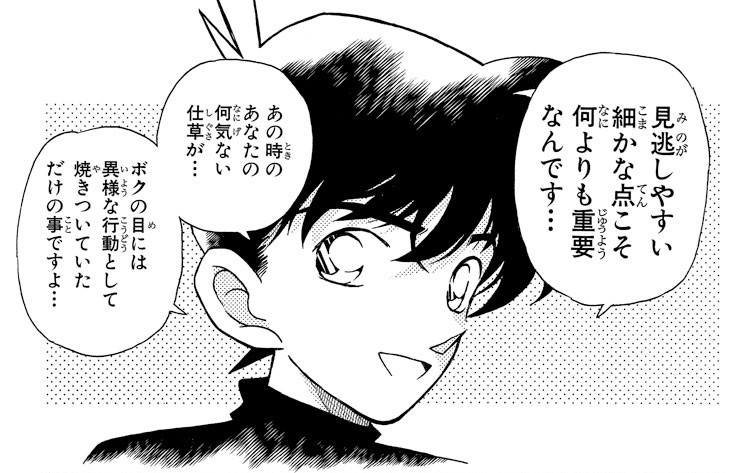
Shin’ichi reveals the details of a murder. The culprit asks how Shin’ichi discovered the hidden weapon, and he explains it was due to a specific movement the culprit made.
- 新一:
- 「見逃しやすい細かな点こそ何よりも重要なんです…」
- “It's precisely those subtle details that are easy to overlook that matter most of all...”
- 「あの時のあなたの何気ない仕草が…」
- “That casual gesture of yours back then...”
- 「僕の目には異様な行動として焼きついてただけの事ですよ…」
- “It's just that it was etched in my mind as strange behavior...”
- Literal: “It's merely that, in my eyes, it was burned in as strange behavior...”
Key Points
- Rather that just ‘a little odd’, 異様 suggests something unnatural, eerie, or out of place in a way that stands out strongly.
- Here, 異様な行動 means Shin’ichi didn’t see the gesture as neutral; he recognized it as a movement that felt suspiciously abnormal in that moment.
- 焼きつく literally means “to burn onto”, and in figurative use it means to be vividly etched into memory.
- 焼きついてた is a casual spoken contraction of 焼きついていた.
Vocabulary
あの (That)
あの comes before a noun to mean “that” or “those”. It points to someone or something away from both speakers, or something they both know about.
時 (Time)
時 means time, a moment, or an occasion.
仕草 (Gesture)
仕草 means a gesture, movement, or mannerism. It often refers to a small action that reveals someone’s mood or character.
僕 (I)
僕 means “I” or “me”. Boys and men commonly use it in casual speech, and it sounds softer than 俺.
異様 (Strangeness)
異様 describes something strange, unsettling, or conspicuously unlike the norm.
行動 (Action)
行動 means action or behavior, especially something done toward a purpose.
See Also
- Kanji: Difference and strangeness with 異
- Future entry: Past tense with 〜た・〜だ
- Grammar: Marking the topic with は and も
- Kanji: Forms and appearances with 様
- Kanji: Going and carrying out with 行
- Kanji: Motion and activation with 動