Strange incidents on after another in Tokyo with 続出
Kanji Explanation: Continuation and connection with 続
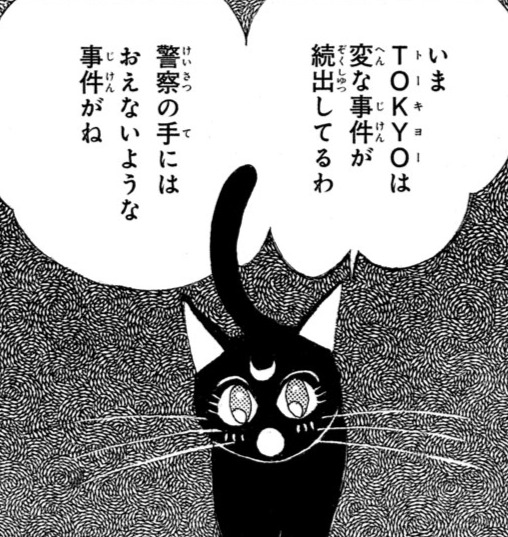
Luna introduces herself to Usagi, but Usagi thinks she’s dreaming if a cat is speaking to her. Luna gives Usagi a special brooch, then proceeds to explain the dire situation that has brought them together.
- ルナ:
- 「いまTOKYOは変な事件が続出してるわ」
- “Strange incidents are popping up all over Tokyo these days.”
- Literal: “Right now in Tokyo, strange incidents are appearing one after another.”
- 「警察の手にはおえないような事件がね」
- “Incidents that seem beyond the police's control, you know.”
Key Points
- In this scene, 続出してる means strange incidents are continuing to pop up in succession, not just that one incident happened.
- It is often used for repeated occurrences of the same kind of thing, especially in news-like or serious contexts.
- The -ている to -てる contraction is very common in speech.
- Here it describes an ongoing situation in Tokyo: incidents are currently appearing one after another.
- Tokyo is the broader topic with は, while 変な事件が is what is doing the appearing.
- A natural fuller gloss is: “As for Tokyo, strange incidents are appearing one after another.”
Vocabulary
| Word | English | Meaning |
|---|---|---|
| いま | Now | いま is the present moment, or these days. It is also written 今. |
| 変 | Strange | 変 describes something odd, unusual, or suspicious. |
| 事件 | Incident | 事件 means an incident or event that attracts public attention. |
| 続出 | One after another | 続出 describes similar things appearing or happening one after another. News reports often use it for a string of problems or incidents. |
| 警察 | Police | 警察 means the police, the institution responsible for enforcing laws and maintaining public order. |
| 手 | Hand | 手 is a hand. It also means a way or means, or help from someone. |
| ような | Like | ような follows a word to compare something to it: “like” or “such as”. At the end of a sentence, it shows the speaker’s impression. |
See Also
- Kanji: Continuation and connection with 続
- Grammar: Ongoing actions and resulting states with 〜ている
- Grammar: Marking the subject with が
- Grammar: Marking the topic with は and も
- Grammar: Seeking agreement with ね
- Grammar: Giving an example with 〜ようだ
- Kanji: Going out and emerging with 出
- Kanji: Hands and skill with 手
- Kanji: Matters and events with 事