Stuck serving the rice with ご飯をよそう
Vocabulary Explanation: Collocations for cooking
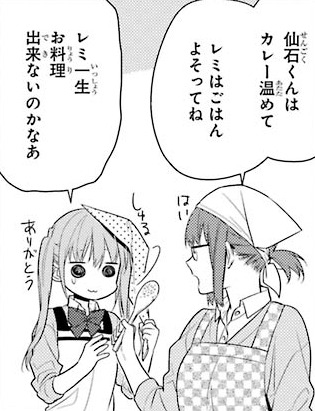
In cooking class, Sakura is in the same group as Remi and Sengoku, who can barely cook. Sakura has banned Remi from using a knife, and Sengoku peeled the potatoes and onions until nothing was left. The rest of the class saw this coming and gave the group a little of their own curry.
- 桜:
- 「仙石くんはカレー温めて レミはごはんよそってね」
- “Sengoku, you heat up the curry. Remi, you serve the rice, okay?”
- 綾崎:
- 「レミ一生お料理出来ないのかなあ」
- “Am I never going to be able to cook?”
- Literal: “I wonder if Remi won't be able to cook for her whole life.”
- 桜:
- 「はい」
- “Here.”
- 綾崎:
- 「ありがとう」
- “Thanks.”
Key Points
- よそう means to scoop food from a pot into individual bowls. It goes with rice and soup: ご飯をよそう, 味噌汁をよそう. English would say “serve” or “dish up”.
- The verbs follow rice from bag to bowl: 米を研ぐ to wash it, ご飯を炊く to cook it, and ご飯をよそう to serve it. The rice paddle Sakura hands Remi is a しゃもじ, the tool for this job.
- In casual speech the を often drops out, as it does here: ごはんよそって. Sakura writes ごはん in kana, a common spelling of ご飯.
- Each は sets one person apart from the other, so the pair splits the work between them. Assigning tasks this way is common: AはX、BはY.
- A bare て-form is a casual request between friends. ね softens it into a friendly instruction, “okay?” Sakura’s first request, 温めて, has no ね, but the ね at the end covers both.
- Remi refers to herself by name, a habit of hers that sounds childlike. 一生 means “my whole life”, and with a negative it means “never”.
- のかなあ wonders aloud about a situation: “is it that I’ll never be able to cook?” Sakura doesn’t answer. She just hands over the rice paddle.
Vocabulary
くん (-kun)
くん is a suffix added to a name, usually for boys or for someone younger or of lower standing. It is also written 君.
カレー (Curry)
カレー is curry, especially Japanese-style curry served over rice. It is short for カレーライス.
温める (To warm up)
温める is to heat something until it is warm, such as food, a drink, or a room. In casual speech it is often pronounced あっためる.
ごはん (Rice)
ごはん is cooked rice, and by extension a meal in general. It is also written ご飯.
よそう (To serve (rice or soup))
よそう is to scoop food such as rice or soup from a pot into individual bowls, as in ご飯をよそう. It can be written 装う, but kana is more common.
一生 (Lifetime)
一生 is the whole span of one’s life, from birth to death.
料理 (Cuisine)
料理 means cooking, cuisine, or a dish. It can refer to making food or to the food you make.
出来る (To be able to)
出来る means to be able to do something. It can also mean that something is made, completed, or comes into existence.
See Also
- Vocabulary: Collocations for cooking
- Grammar: Requests with 〜てください and 〜てくれ
- Grammar: Marking the topic with は and も
- Grammar: Wondering with かな
- Kanji: Going out and emerging with 出