Stuck up a tree with 〜ていたところを
Grammar Explanation: Timing of an action with 〜ところだ
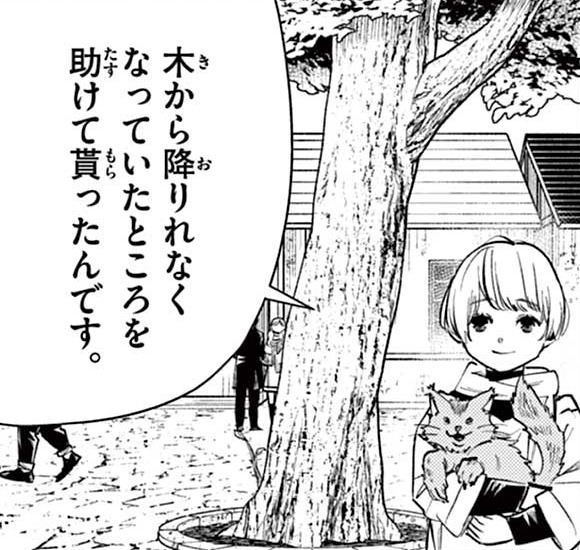
Frieren tells Fern that today is Stark’s eighteenth birthday, and Fern has no idea what he wants for a present. She decides to sound him out directly, but he isn’t in his room. Fern asks around town. A woman says the warrior with the axe helped push her cart, then headed toward the plaza.
- 女の子:
- 「木から降りれなくなっていたところを助けて貰ったんです。」
- “He helped us when we couldn't get down from the tree.”
Key Points
- ところ marks a point in time. With を, that situation becomes what the next verb acts on. Verbs like 助ける, 見る, and 捕まえる often follow, because they stop or catch the situation as it happens.
- The 〜ていた form says the trouble had been going on right up to that moment. They had been stuck for a while, and Stark arrived and ended it.
- Compare ところに, which has something new arrive at that point. With ところを, the next verb acts on the situation itself.
- 降りる is “to get down”. Its standard potential form is 降りられる. The girl drops the ら and says 降りれる, which is common in everyday speech.
- 〜なくなる is “to become unable to”. 降りれなくなる is getting into a state where you can’t get down.
- 〜ていた turns that change into an ongoing state in the past: they had become stuck and stayed stuck.
- 〜てもらう says the speaker received someone’s action. Stark did the helping, and the girl received it. She doesn’t name the one who got stuck. The cat in her arms suggests it was the cat, but she counts the favor as her own.
- 貰う is usually written in kana, as もらう. The kanji spelling is a little old-fashioned.
- んです explains. Fern is asking about Stark, and the girl offers this as her part of the answer.
Vocabulary
木 (Tree)
木 is a tree, or wood.
降りる (To come down)
降りる is to come down from a high place, or to get off a vehicle.
なる (To become)
なる is to change into a different state or become something. It also means something turns out a certain way. It is also written 成る.
ところ (Place)
ところ is a place or spot. It also refers to a point in time or a certain aspect of something. It is also written 所.
助ける (To help)
助ける is to help or rescue someone.
貰う (To receive)
貰う is to receive something from someone. After a て-form verb, it means to have someone do something for you. It is more often written in kana as もらう.
See Also
- Grammar: Timing of an action with 〜ところだ
- Grammar: Having someone do something with 〜てもらう
- Grammar: Able to do with 〜れる・〜られる
- Grammar: Reasoning with 〜のだ