Supplying a shop at the foot of the valley with 卸す
Vocabulary Explanation: Getting off and coming down with おりる
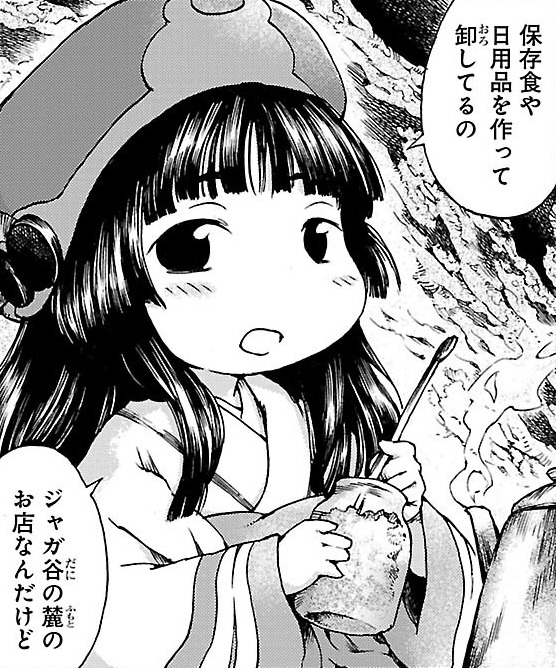
Konju visits Hakumei and Mikochi’s new house with a housewarming gift of herbal tea. She finds Mikochi in a basement packed with jars and bundles, and asks why she’s gone out of her way to clutter the place up. Mikochi tells her it’s for work.
- ミコチ:
- 「保存食や日用品を作って卸してるの」
- “I make preserved food and household goods and sell them to a shop.”
- Literal: “I make preserved food, daily goods, and so on, and wholesale them.”
- 「ジャガ谷の麓のお店なんだけど」
- “It's a shop at the foot of Jaga Valley.”
Key Points
- 卸す is a maker or a wholesaler selling goods to a shop. The shop then sells them to its own customers. Mikochi’s jars and bundles are stock for the shop at the foot of Jaga Valley.
- おろす has other spellings with other meanings: 下ろす is “take down” or “grate”, and 降ろす is “let someone off”. The official guide gives 卸 only the trade meaning, so the kanji settles which おろす this is. The manga adds furigana because 卸 is a less common kanji.
- Related words include 卸値, the wholesale price, and 卸売り, the wholesale trade.
- 作って joins two steps: Mikochi makes the goods, then sells them to the shop.
- 卸してる is the casual contraction of 卸している. Here ている describes a habit or a line of work, not something happening right now.
- や lists examples without claiming the list is complete. 保存食や日用品 is “preserved food, household goods, and the like”, and the basement shows plenty of other things too.
- The の at the end of the first line explains things to Konju, who just asked why the house is cluttered. It’s the casual form of 〜のだ.
- なんだけど adds background and leaves the sentence open for Konju to react. Here it sets up the shop’s location, and she recognizes it in the next panel.
Vocabulary
| Word | English | Meaning |
|---|---|---|
| 保存食 | Preserved food | 保存食 is food prepared to keep for a long time, such as pickles, jam, dried food, or canned goods. |
| 日用品 | Daily necessities | 日用品 are everyday household goods, such as soap, dishes, and cleaning supplies. |
| 作る | To make | 作る means to create or prepare something. |
| 卸す | To sell wholesale | 卸す is for a maker or a wholesaler to sell goods to a shop, which then sells them to its own customers. |
| 谷 | Valley | 谷 is a valley, the low ground between hills or mountains. In place names it often becomes だに, as in ジャガ谷. |
| 麓 | Mountain foot | 麓 is the area at the base of a mountain, where the slope levels out and villages often sit. |
| お店 | Shop | お店 is a polite word for a shop or restaurant. |
See Also
- Vocabulary: Getting off and coming down with おりる
- Grammar: Ongoing actions and resulting states with 〜ている
- Grammar: Connecting actions with 〜て・〜で
- Grammar: Reasoning with 〜のだ
- Grammar: But with 〜けど and 〜けれど
- Kanji: Eating and food with 食
- Kanji: Goods and refinement with 品
- Kanji: Making and creating things with 作