Swapping out the toilet light with 換える
Vocabulary Explanation: Changing and swapping with かえる and かわる
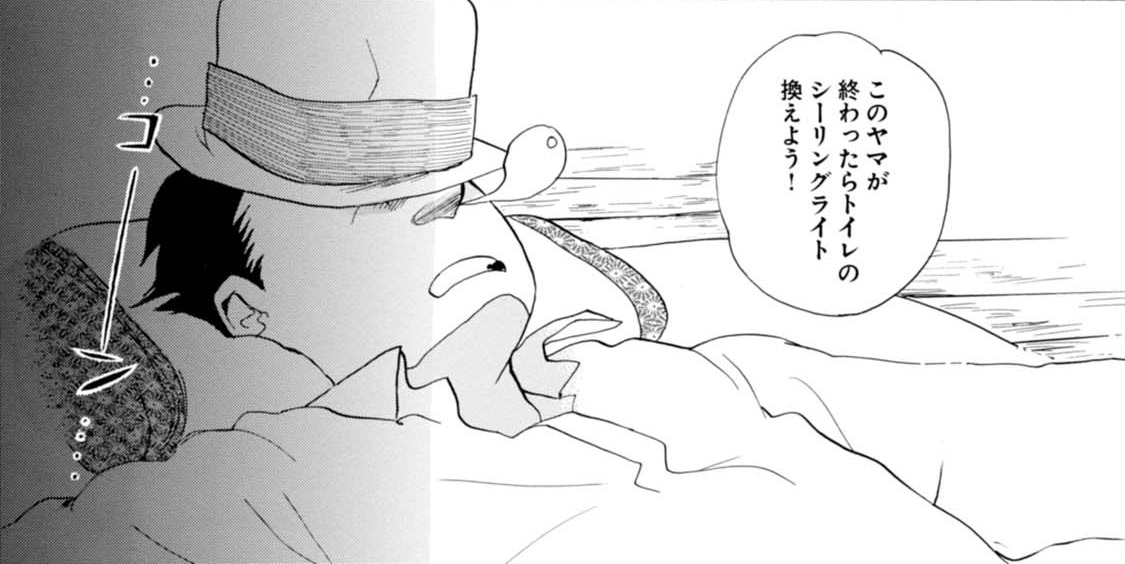
Detectives Bekkan and Steve are investigating an attack on Machi, and with the bridge out of the village down, they’re staying the night in an old house. Bekkan tells Steve to keep watch, but Steve falls asleep. Writing his notes under a bare bulb, Bekkan first grumbles that it’s dark, then decides it’s stylish in its own way, and oddly calming.
- ベッカン:
- 「このヤマが終わったらトイレのシーリングライト換えよう!」
- “Once this case is wrapped up, I'm swapping out the ceiling light in my toilet!”
Key Points
- Bekkan means taking down the fixture he has now and putting up a different one. He doesn’t say what he’ll put up, but he has just decided a bare bulb is stylish and calming.
- The official guide files trading one thing for another under 換 and “new in place of old” under 替, so 替える and 取り替える are common for lights too. The manga writes 換, treating it as a straight swap.
- Changing the light’s color or brightness would be 変える. Here the fixture itself is replaced.
- Detectives call a case they’re working a ヤマ. Katakana marks it as jargon, not the ordinary word 山, “mountain”.
- このヤマ is “this case”, the attack they came to the village to investigate.
- The case is sure to end at some point, so 終わったら is “once it’s over”, not “if”. It sets when the light gets swapped.
- 換えよう is the volitional of 換える. Steve is asleep, so this isn’t “let’s”. Bekkan is making up his mind out loud: “I’m going to swap it.”
- The particle を after シーリングライト is dropped, as it often is in casual speech.
Vocabulary
| Word | English | Meaning |
|---|---|---|
| この | This | この means “this” or “these” and comes directly before a noun. It points to something near the speaker or something the speaker is referring to in the conversation. |
| ヤマ | Case (police slang) | ヤマ is police and criminal slang for a case or a job. Detectives call the case they’re working on このヤマ. It’s the word 山, “mountain”, usually written in katakana for this sense. |
| 終わる | To end | 終わる is for something to come to an end. After a verb stem, it means to finish doing it. |
| トイレ | Toilet; restroom | トイレ means a toilet or restroom. |
| シーリング | Ceiling | シーリング is a ceiling, mostly seen in compounds like シーリングライト, a light fixture mounted flat against the ceiling. On its own it can also mean a cap or upper limit. |
| ライト | Light | ライト is a light, such as a lamp, a headlight, or a light fixture. It can also mean “light” as in not heavy, or right field in baseball. |
| 換える | To exchange, to swap | 換える is to exchange one thing for another, as in turning goods into cash or switching trains. In everyday writing it overlaps with 替える, “replace with something new”. |
See Also
- Vocabulary: Changing and swapping with かえる and かわる
- Grammar: If and when with 〜たら
- Grammar: Volitional with 〜う・〜よう