Switching uniforms with 〜っけ
Grammar Explanation: Remembering with 〜っけ
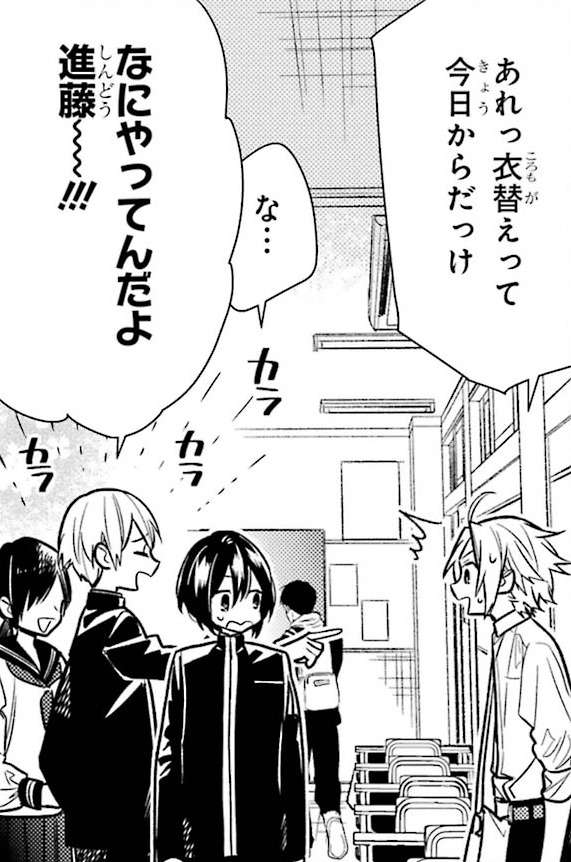
One morning, Miyamura and his classmates are wearing the black, high-collared jackets of the winter uniform. Shindou walks into the classroom in a white summer shirt.
- 進藤:
- 「あれっ 衣替えって今日からだっけ」
- “Huh? Was the uniform change supposed to start today?”
- 宮村:
- 「な…」
- “Wh...”
- 同級生:
- 「なにやってんだよ進藤〜〜!!!」
- “What are you doing, Shindou?!”
Key Points
1Checking a memory with だっけ
- だっけ is the copula だ plus っけ. 今日からだ means “it starts today,” and adding っけ turns it into a check on his memory: “it starts today, was it?”
- The question is about today, so no past form is needed. 今日からだったっけ would also work, pointing back to when he heard the date.
- He’s half talking to himself, but he says it out loud in front of the class, and his classmates react right away.
2Surprise with あれっ
- あれ is “huh?” when something doesn’t match what the speaker expected. The small っ cuts it short, like a quick gasp.
- It often comes before っけ. The sight of everyone in black jackets is what makes Shindou doubt the date he had in mind.
3Bringing up a topic with って
- In casual speech, って can mark the topic, much like は: 衣替えって, “the uniform change.”
- It’s short for っていうのは, "the thing called." The comment that follows, 今日からだっけ, is a question about that topic.
4衣替え
- 衣替え is the seasonal change of clothes. Japanese schools set dates for switching uniforms, commonly June 1 for summer uniforms and October 1 for winter ones.
- Here the class has switched to the black, high-collared winter jacket, and Shindou is still in his summer shirt.
5なにやってんだよ
- やってん is a casual contraction of やっているの. 〜ている shrinks to 〜てる, the の becomes ん, and the る before it also turns into ん: やっているんだ → やってんだ.
- なにやってんだよ is “what are you doing?” said in disbelief. The classmate is laughing as he says it, so it’s teasing, not a real scolding.
Vocabulary
今日 (Today)
今日 means today. In formal writing, it can also mean the present day or current era.
なに (What)
なに asks what something is. Said alone, it shows surprise or annoyance: “what?” It is also written 何.
やる (To do)
やる is a casual word for “to do”. It also means to give something to someone of lower standing, or to animals and plants.
See Also
- Grammar: Remembering with 〜っけ
- Grammar: Quoting and reporting with と and って
- Grammar: How casual contractions work
- Grammar: The copula だ
- Grammar: Reasoning with 〜のだ
- Kanji: Now and the present with 今
ホリミヤ © its respective creators. It is used here for educational commentary.