Taking back a question with 〜ことにする
Grammar Explanation: Deciding to with 〜ことにする
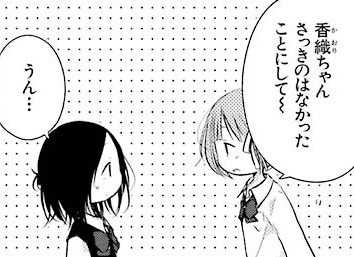
Saki has noticed that Fujimiya suddenly acts cool toward Hase, and decides to find out why. She assumes Hase must have made a pass at her, and asks Fujimiya straight out what kind of sexual harassment he subjected her to. Kiryu pulls Saki aside and tells her to ask the question again without assuming harassment. Saki goes back to Fujimiya.
- 沙希:
- 「香織ちゃん さっきのはなかったことにして~」
- “Kaori, pretend what I said just now never happened~”
- 藤宮:
- 「うん…」
- “Okay...”
Key Points
- なかった is the past form of ない, “not exist” or “not happen”. ことにする after it means treating something as so, whether or not it is.
- Together, なかったことにする means “act as though it never happened”. It’s a common way to take back something embarrassing.
- Saki did ask the question. She’s asking Fujimiya to go along with pretending she didn’t.
- さっき is “a moment ago”. の stands in for a noun Saki doesn’t need to name, here the question she just asked.
- は makes さっきの the topic: “as for what I said just now”.
- Ending a sentence with a て-form, here して, is a casual request, like a shortened してください.
- The drawn-out ~ makes it sound wheedling. Saki is playing it off lightly after her blunder.
Vocabulary
さっき (A moment ago)
さっき is a short time before now.
ない (Not)
ない means something does not exist or someone does not have it. After a verb, it makes the verb negative. It is also written 無い.
こと (Thing)
こと is an abstract thing, matter, or fact, as opposed to a physical object. It also turns a verb phrase into a noun, as in 見たことがある. It is also written 事.
する (To do)
する is to do or perform something. It also turns many nouns into verbs, as in 勉強する.
See Also
- Grammar: Deciding to with 〜ことにする
- Grammar: Requests with 〜てください and 〜てくれ
- Grammar: Negation with 〜ない