Taking rice balls to Sadao with にぎり飯
Vocabulary Explanation: Collocations for cooking
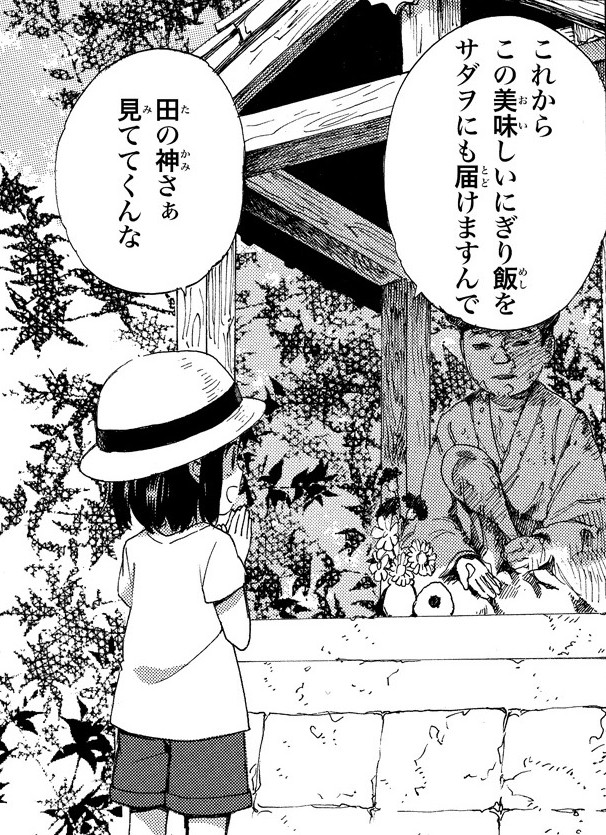
Hinata lived her first life as an old woman, and she misses her grandson Sadao, whom she hasn’t seen in over six years. She packs a lunch and sets out by bicycle for her old home to see him. After a long ride she notices it’s already noon, and she stops at a roadside shrine to the god of the rice fields.
- ひなた:
- 「これからこの美味しいにぎり飯をサダヲにも届けますんで」
- “I'm off to take these delicious rice balls to Sadao too,”
- Literal: “From now, I will deliver this delicious rice ball to Sadao too, so...”
- 「田の神さぁ 見ててくんな」
- “...watch over me, god of the fields.”
Key Points
- にぎり飯 is rice pressed into a ball by hand. The にぎり comes from 握る, “to squeeze”, the same verb used in おにぎりを握る.
- 飯 is an older, rougher word for cooked rice or a meal than ご飯. にぎり飯 sounds old-fashioned next to おにぎり, which suits a speaker who was a grandmother in her first life.
- 届ける means to deliver or bring something to someone. に marks who receives it.
- も after に adds Sadao to the people who get the rice balls: “to Sadao too”.
- これから means “from now”. With a ます verb, it announces what she is about to go do.
- Hinata speaks plainly most of the time, but she switches to 届けます here. She is speaking to the god of the fields and shows respect.
- 田の神さぁ is how she addresses him. さぁ is a rustic version of the honorific さま.
- んで is a casual contraction of ので. 届けますんで is 届けますので, “since I’ll be delivering it”.
- The reason comes first and the request second. In English, “so” fits better: “I’m taking these to Sadao, so watch over me.”
- 見てて is 見ていて, the て-form of 見ている, with い dropped. It asks for continued watching, not a single look.
- くんな here is a dialect request close to くれな or くださいな. It is not the prohibitive くるな, “don’t come”, which follows the plain form of くる.
Vocabulary
これから (From now on)
これから means starting from this moment, or later on in the future.
この (This)
この means “this” or “these” and comes directly before a noun. It points to something near the speaker or something the speaker is referring to in the conversation.
美味しい (Delicious)
美味しい describes food or drink that tastes good.
にぎり飯 (Rice ball)
にぎり飯 is cooked rice pressed into a ball by hand. It is an older, homier word for おにぎり.
届ける (To deliver)
届ける is to take something to someone. It also means to report something to an office, such as the police.
田の神 (God of the rice fields)
田の神 is the god who watches over rice fields and the harvest. Farming villages honor it with roadside statues and festivals.
見る (To see)
見る is to see, look at, or watch something. It also means to check or judge something, or to look after someone, as in 面倒を見る.
See Also
- Vocabulary: Collocations for cooking
- Grammar: Objective reason with 〜ので
- Grammar: Polite style with です and ます
- Grammar: Ongoing actions and resulting states with 〜ている
- Grammar: Requests with 〜てください and 〜てくれ
- Grammar: Marking the topic with は and も
- Kanji: Seeing and viewpoints with 見
- Kanji: Taste and meaning with 味