Taking the star jam off the heat with 火を止める
Vocabulary Explanation: Collocations for cooking
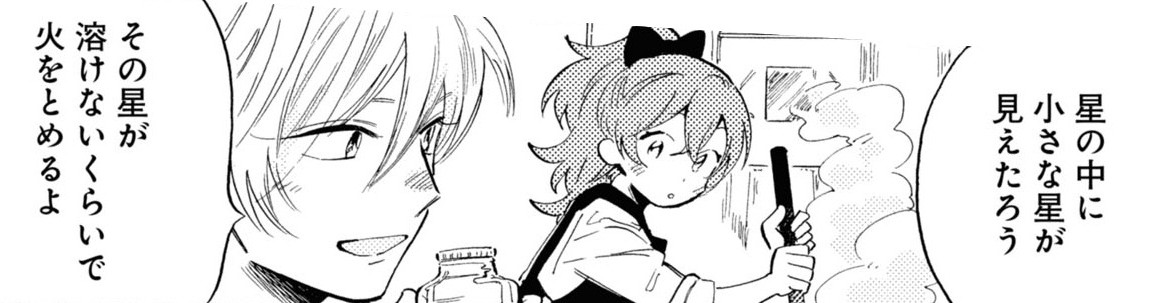
Mira and her master are making jam from stars that fell into the clouds. The master stirs the stars and sugar in a pot until they begin to melt, then lets Mira take over. As she stirs, a glint streaks through one of the melting stars, and she says it looks like a shooting star.
- 師匠:
- 「星の中に小さな星が見えたろう」
- “You saw little stars inside the star, didn't you?”
- 「その星が溶けないくらいで火をとめるよ」
- “We take it off the heat before those stars melt.”
Key Points
- とめる is 止める, “to stop”, written in kana. With 火 as its object, it means turning off the stove’s flame.
- 火を消す also works. The opposite is 火にかける, putting a pot over the flame.
- The plain form with よ gives the next step of the recipe as information for Mira: “we turn it off.”
- くらい marks a degree or extent. After the negative 溶けない, it means “about as far as not melting yet”.
- で marks that degree as the point to act. Together, 溶けないくらいで火をとめる says to cut the heat while the stars are still whole.
- たろう is short for ただろう. The master isn’t guessing. He expects Mira to agree, since she just reacted to the sparkle.
- 見える means “to be visible”, so what she sees takes が: 小さな星が見えた, “little stars were visible”.
- その refers to something just mentioned. その星 means the little stars from his first line, not the big melting stars in the pot.
Vocabulary
星 (Star)
星 is a star in the sky. It also means a star shape or a mark of rank.
中 (Inside)
中 is the inside of something, or the middle of a situation.
小さな (Small)
小さな means small or little. It comes only directly before a noun, as in 小さな星, and is a little softer than 小さい.
見える (To be visible)
見える is for something to be seen. It also means to seem or look a certain way.
その (That)
その points to something near the listener or to something just mentioned. Said alone, it fills a pause, like “um”.
溶ける (To melt)
溶ける is for a solid to melt into liquid, as ice or sugar does when heated. It also means to dissolve into a liquid.
くらい (About)
くらい after a number or amount means “about” or “around”. With は, as in 一人くらいは, it means “at least”. It is also pronounced ぐらい.
火 (Fire)
火 is fire or flame. In cooking, it also means the heat of a stove, as in 火を通す, “to cook something through”.
とめる (To stop, to fasten)
とめる is to stop something moving or running, as in 火をとめる, “turn off the heat”. Written 止める in this sense. It also means to fasten or fix something in place, such as with a pin or a clip, written 留める.
See Also
- Vocabulary: Collocations for cooking
- Grammar: Presuming with 〜だろう and 〜でしょう
- Grammar: Informing with よ
- Kanji: Seeing and viewpoints with 見