Tasting Kiyo's tonjiru with 味見
Vocabulary Explanation: Collocations for cooking
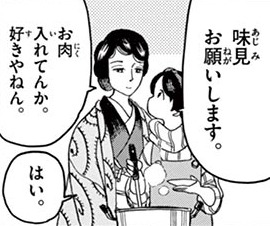
Momoko has dropped by the house and sat quietly watching Kiyo work in the kitchen. When Kiyo starts on dinner, she invites Momoko to stay and eat with everyone, and Momoko brightens when she hears it will be tonjiru, a miso soup full of pork and vegetables. Now the soup is done.
- キヨ:
- 「味見お願いします。」
- “Would you taste it for me?”
- 百子さん:
- 「お肉入れてんか。好きやねん。」
- “Put some meat in, would you? I love it.”
- キヨ:
- 「はい。」
- “Sure.”
Key Points
- 味見 is a taste test during cooking. The cook takes a sip or a bite to check the flavor before serving. The 見 means checking, as in 〜てみる, “try and see”, not looking with the eyes.
- A noun followed by お願いします asks someone to do that thing for you: 会計お願いします, “the check, please”. The full form is 味見をお願いします, and speech often drops the を.
- It’s a polite way to ask Momoko, a guest, for her opinion. Talking to a friend, Kiyo might say 味見して or 味見してみて.
- 〜てんか is a Kansai request ending. It works like 入れてくれないか or 入れてくれ, “would you put it in”.
- Momoko doesn’t comment on the flavor. She asks for more meat in her dish instead.
- やねん is the Kansai version of なんだ. や replaces the copula だ, and ねん replaces explanatory のだ. 好きやねん matches 好きなんだ, giving her reason for wanting more meat.
Vocabulary
味見 (Tasting)
味見 is tasting food while cooking it to check the flavor. A cook takes a small sip or bite before serving, often to decide whether it needs more seasoning.
お願い (Request)
お願い is a request or favor. On its own, it also means “please”. お願いする means to ask someone for something.
肉 (Meat)
肉 is meat, the flesh of animals eaten as food. It also means the flesh of the body or the soft part of a fruit.
入れる (To put in)
入れる is to put something inside something else. It also means to let someone in, or to make tea or coffee.
好き (Liked)
好き describes something you like or someone you love.
See Also
- Vocabulary: Collocations for cooking
- Grammar: Grammar in the Kansai dialect
- Kanji: Entering and putting in with 入
- Kanji: Seeing and viewpoints with 見
- Kanji: Taste and meaning with 味