Testing one's detective ability with 能力
Kanji Explanation: Ability and capability with 能
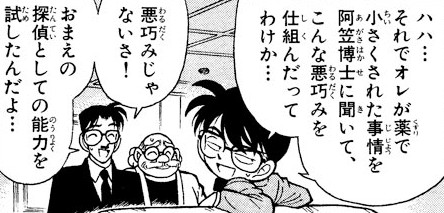
Conan finds himself in the clutches of a dangerous pair, only to discover it’s his parents in disguise.
- コナン:
- 「ハハ… それでオレが薬で小さくされた事情を阿笠博士に聞いて、こんな悪巧みを仕組んだってわけか…」
- “So you heard from Dr. Agasa about how I was shrunk by a drug and cooked up this evil scheme, huh...”
- 父さん:
- 「悪巧みじゃないさ! おまえの探偵としての能力を試したんだよ…」
- “It's not an evil scheme! I was just testing your abilities as a detective...”
- Literal: “It isn't an evil scheme! I tested your ability as a detective...”
Key Points
- Here 能力 means Conan’s capability as a detective.
- It refers to overall ability, broader than one specific skill.
- としての frames the standard or role being judged.
- The father is specifically testing Conan’s competence as a detective, not as a child or son.
- 試したんだ is the past 試した plus explanatory んだ.
- It gives the line a relaxed but explanatory tone: “I was testing you, that’s all.”
- それで at the start of a sentence refers back to something previously said and introduces the result, much like “so” or “therefore” or “and then”.
Vocabulary
| Word | English | Meaning |
|---|---|---|
| オレ | I | オレ is a katakana spelling of おれ, a casual, masculine word for “I”. It is also written 俺. |
| 薬 | Medicine | 薬 is something taken or applied to treat illness or injury. It can also mean a chemical, or an illegal drug. |
| 小さい | Small | 小さい describes something small in size. 小さいころ means “when one was little”. |
| する | To do | する is to do or perform something. It also turns many nouns into verbs, as in 勉強する. |
| 事情 | Circumstances | 事情 means the circumstances of a situation, including what led to it and why. |
| 博士 | Doctor | 博士 is a title for a learned expert or scientist, often translated as Doctor when attached to a name. The reading はくし refers to a doctoral degree or a person who holds one. |
| 聞く | To hear | 聞く is to hear or listen to something. It also means to ask a question. |
| こんな | Like this | こんな describes something like the thing in front of the speaker or the thing just mentioned. |
| 悪巧み | Scheme | 悪巧み is a plan to trick or harm someone, hatched in secret. |
| 仕組む | To plot | 仕組む is to plan or set up a scheme in secret. |
| わけ | Reason | わけ is a reason or meaning. It also appears in grammar patterns such as わけがない, “there’s no way”, and わけにはいかない, “can’t very well”. |
| おまえ | You | おまえ is a casual, rough word for “you”. Men often use it toward people of equal or lower standing. It is also written お前. |
| 探偵 | Detective | 探偵 means a detective or private investigator who gathers information about people or incidents. |
| とする | As | とする appears in として, “as” or “in the role of”. It also appears in 〜とする, “to assume” or “to decide on”. |
| 能力 | Ability | 能力 means ability or capacity. It can be innate or developed through learning and experience. |
| 試す | To test | 試す is to try something out to see how it works or how good it is. |
See Also
- Kanji: Ability and capability with 能
- Grammar: Past tense with 〜た・〜だ
- Grammar: Receptive verbs with 〜れる
- Grammar: Negation with 〜ない
- Grammar: Marking the direct object with を
- Grammar: The copula だ
- Grammar: Informing with よ
- Grammar: Compound voicing with 連濁
- Grammar: How casual contractions work
- Grammar: Casual emphasis with さ
- Grammar: Logical conclusion with 〜わけだ
- Kanji: Matters and events with 事
- Kanji: Searching and probing with 探
- Kanji: Testing and trying with 試