Thank you for the water with ありがとうございました
Vocabulary Explanation: Ways to say thank you in Japanese
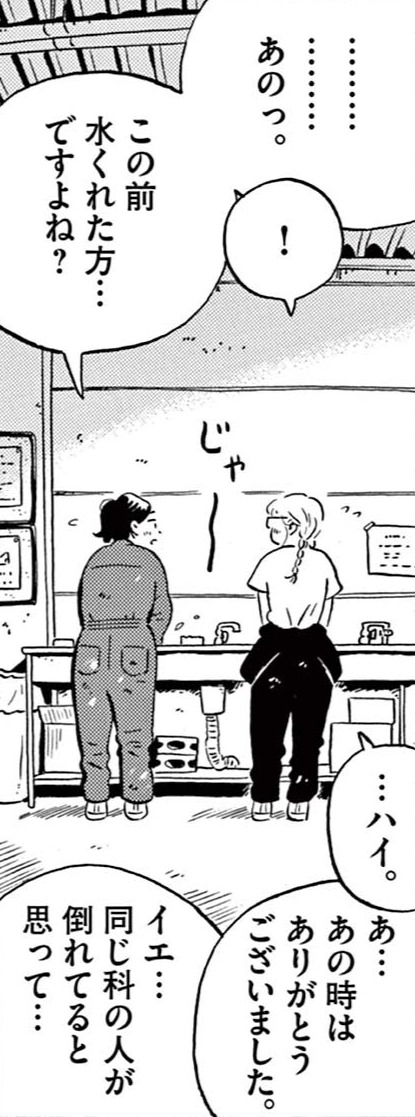
Natsumi tried making new friends from college only to end up drunk and abandoned. At class one day, she finds herself face to face with the helpful person who had found her and briefly helped her afterward.
- なつみ:
- 「……… ……… あのっ。」
- “Um...”
- 「この前水くれた方…ですよね?」
- “You're the one who gave me water before...right?”
- 女:
- 「…はい。」
- “...yes.”
- なつみ:
- 「あ…あの時はありがとうございました。」
- “Ah... Thank you for what you did back then.”
- 女:
- 「イエ…同じ科の人が倒れてると思って…」
- “Not at all... I thought it was someone from the same department who had collapsed...”
Key Points
1ありがとうございました looks back on completed help
- Natsumi is thanking the woman for helping her on an earlier occasion, so the past polite form fits better than ありがとうございます.
2あの時は = “back then” or “on that occasion”
- は makes the earlier occasion the frame for Natsumi’s thanks.
3水くれた方 = “the person who gave me water”
- A fuller version is 水をくれた方. Natsumi drops the object particle を in conversation.
- くれた presents giving the water as help Natsumi received. 方 is a respectful way to say “person”.
4ですよね asks for confirmation
- Natsumi believes she recognizes the woman but wants to check. よ puts forward her conclusion, and ね asks the woman to confirm it.
5倒れてると思って trails off with an explanation
- 倒れてる contracts 倒れている. With this verb, it describes the resulting state of having collapsed.
- と marks 同じ科の人が倒れてる as what the woman thought. Ending on 思って… leaves her reason unfinished, which helps her modestly brush off the thanks.
Vocabulary
あの (That)
あの comes before a noun to mean “that” or “those”. It points to someone or something away from both speakers, or something they both know about.
時 (Time)
時 means time, a moment, or an occasion.
思う (Think)
思う means to think, feel, believe, expect, or hope.
See Also
- Vocabulary: Ways to say thank you in Japanese
- Grammar: Polite style with です and ます
- Grammar: Receiving kindness with 〜てくれる
- Future entry: Seeking agreement with ね
- Grammar: Ongoing actions and resulting states with 〜ている
- Grammar: Quoting and reporting with と and って
ひらやすみ © its respective creators. It is used here for educational commentary.