Thanks for the mochi with どうも
Vocabulary Explanation: Ways to say thank you in Japanese
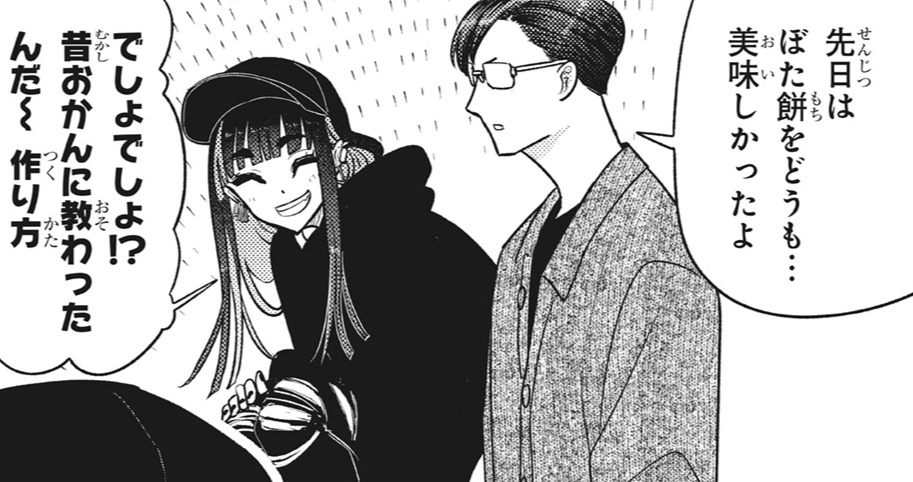
Kumada’s neighbor gave him extra mochi when she made too much. A few days later, he sees her in the park.
- 熊田:
- 「先日はぼた餅をどうも… 美味しかったよ」
- “Thanks for the botamochi the other day... They were really delicious.”
- 隣さん:
- 「でしょでしょ!? 昔おかんに教わったんだ〜 作り方」
- “Right?! I learned how to make them from my mom a long time ago~”
Key Points
1どうも is a brief standalone “thanks” here
- どうも can also be a greeting, but 先日はぼた餅を makes gratitude the clear reading in this scene.
- 先日は looks back to “the other day”, and ぼた餅を names the gift he is thanking her for.
2美味しかったよ = “They were delicious”
- 美味しい becomes 美味しかった because Kumada has already eaten the botamochi.
- Sentence-final よ tells his neighbor his evaluation. It contrasts with her でしょ, which asks him to agree.
3でしょでしょ asks for enthusiastic agreement
- でしょ is the conversational form of でしょう. With rising intonation, it means “right?”
- Repeating it gives the neighbor’s response an excited “Right?! Right?!” rhythm.
4おかんに教わったんだ supplies the explanation
- おかん is a casual word for “mom”. With 教わる, the particle に marks the person she learned from.
- んだ is casual explanatory のだ. She explains why her homemade botamochi turned out so well.
5作り方 arrives as an afterthought
- A fuller, regular order would be 昔おかんに作り方を教わったんだ.
- She finishes the sentence first, then adds 作り方 to clarify what her mother taught her. The object marker を is understood.
See Also
- Vocabulary: Ways to say thank you in Japanese
- Grammar: Presuming with 〜だろう and 〜でしょう
- Grammar: Reasoning with 〜のだ
- Future entry: Past tense with 〜た・〜だ
- Future entry: Informing with よ
くまぐらし © its respective creators. It is used here for educational commentary.