That said, she'll still show her homework with 〜つつも
Grammar Explanation: Contradicting with 〜つつも
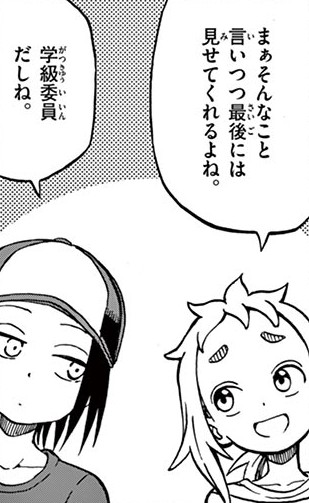
As summer break is half over, talk of summer homework comes up. Yukari says she won’t let Mina copy off of hers.
- ミナ:
- 「まぁそんなこと言いつつ最後には見せてくれるよね」
- “Well, even though she says that, she'll show it to me in the end, you know.”
- Literal: “Well, while saying things like that, in the end she'll show it to us, right?”
- サナエ:
- 「学級委員長だしね」
- “She is the class representative, after all.”
Key Points
1言いつつ = “while saying that / even though she says that”
- Here つつ marks a concessive idea: Mina means “even though Yukari says that now…”
- The omitted も is understood from context, so the sense is still basically 〜つつも.
2そんなこと refers to Yukari’s refusal
- そんなこと points back to Yukari saying she will not let Mina copy her homework.
- Mina is dismissing that statement as something Yukari says now, not as the final outcome.
3最後には signals the eventual result
- 最後には means “in the end” or “eventually”.
- It sets up Mina’s expectation that Yukari will still cave later.
4見せてくれる adds the nuance of doing her a favor
- くれる shows the action as something done for Mina’s benefit.
- So 見せてくれる is not just “show it” but “show it to me” with the giver oriented toward the speaker.
5よね seeks agreement
- The ending よね sounds like Mina is asserting her view while also expecting Sanae to agree.
Vocabulary
言う (To say)
言う means to say or tell. It can also mean to call something by a particular name.
最後 (Last)
最後 means the end, the last one, or the final stage.
学級委員長 (Class president)
学級委員長 a student who serves as the leader of a school class. This student leads the class representatives and is entrusted with significant responsibilities.
See Also
- Grammar: Contradicting with 〜つつも
- Grammar: Receiving kindness with 〜てくれる
- Grammar: Marking the topic with は and も
- Kanji: After and behind with 後
- Kanji: Learning and schooling with 学
あしたは土曜日 © its respective creators. It is used here for educational commentary.