That teaching style with あれ
Vocabulary Explanation: That over there with あれ
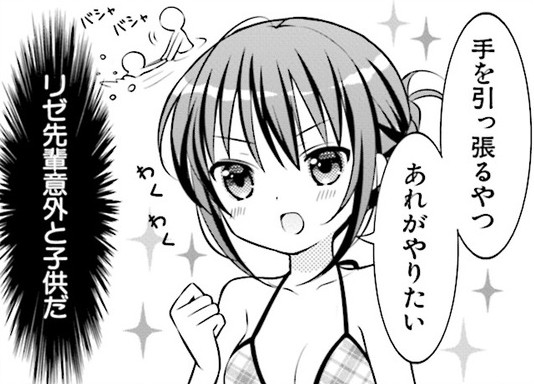
At a pool visit, it’s learned that Rize doesn’t know how to swim. Syaro suggests she practice using a kickboard, but there’s something Rize is more interested in trying.
- リゼ:
- 「手を引っ張るやつ あれがやりたい」
- “Being pulled along by the hands. I want to try that.”
- シャロ:
- 「リゼ先輩意外と子供だ」
- “Rize-senpai is surprisingly childish.”
Key Points
- Rize points back to being pulled through the water by the hands, so あれ means “that” as an idea rather than a distant object.
- やつ turns the preceding clause into “the thing where someone pulls your hands”, preparing the reference picked up by あれ.
- が marks “that” as what Rize wants to do, while the scene supplies swimming practice as the broader context.
- Syaro judges Rize’s eagerness to be surprisingly childish rather than literally calling her a child.
Vocabulary
| Word | English | Meaning |
|---|---|---|
| 手 | Hand | 手 is a hand. It also means a way or means, or help from someone. |
| 引っ張る | To pull | 引っ張る is to pull or tug something toward you. It also means to lead a group. |
| やつ | Guy | やつ is a casual word for a person or thing. It can sound rough or friendly, depending on the speaker. It is also written 奴. |
| あれ | That | あれ points to something far from both the speaker and the listener, or to something both already know about. Said alone with a rising tone, it shows surprise, like “huh?” |
| やる | To do | やる is a casual word for “to do”. It also means to give something to someone of lower standing, or to animals and plants. |
| 先輩 | Senior | 先輩 is a senior member of the same school, workplace, or group, usually someone who joined earlier or has more experience. |
| 意外 | Unexpected | 意外 describes something surprising, not what one expected. |
| 子供 | Child | 子供 is the everyday word for a child. It can also refer to children as a group. |
See Also
- Vocabulary: That over there with あれ
- Grammar: The copula だ
- Grammar: Marking the direct object with を
- Kanji: Childhood and small things with 子
- Kanji: Hands and skill with 手
- Kanji: Thought and intention with 意