The French queen sent to the guillotine with 王妃
Kanji Explanation: Royal consorts with 妃
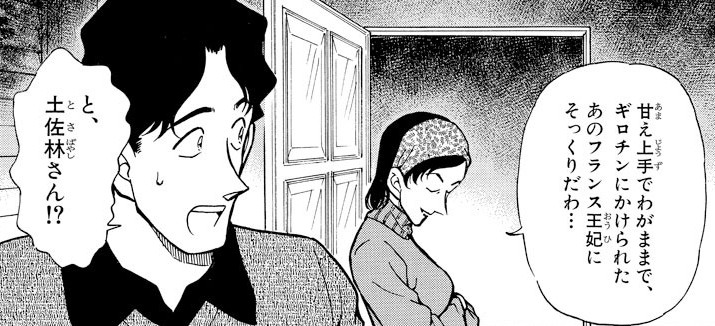
Professor Agasa and the children are at Mr. Kanou’s house, where his family is giving away his late grandfather’s antiques. Kanou shows off his mother’s papillon, Doyle, a prize-winning show dog. A fellow dog lover explains that the breed was a favorite of the 16th-century French court and that Marie Antoinette’s dog is said to have been a papillon. A woman’s voice then remarks on what an elegant, refined little dog Doyle is.
- 土佐林:
- 「甘え上手でわがままで、ギロチンにかけられたあのフランス王妃にそっくりだわ…」
- “Good at getting pampered, and so willful... just like that French queen they sent to the guillotine...”
- 加納:
- 「と、土佐林さん!?」
- “M-Ms. Tosabayashi!?”
Key Points
- 王妃 means a queen in the sense of a king’s wife: 王 “king” plus 妃 “consort”. Marie Antoinette fits exactly, since she was queen through her marriage to Louis XVI.
- A queen who reigns in her own right is a 女王. English uses “queen” for both, but Japanese keeps them apart.
- あの here points to someone the listeners already know about, “that French queen”. Everyone has just heard about Marie Antoinette’s papillon, so Ms. Tosabayashi doesn’t need to say her name.
- ギロチンにかけられた describes the queen. かけられた is the passive past of かける, so the queen was the one put to the guillotine.
- 甘え上手 describes someone who knows how to act sweet to get pampered. わがまま means selfish or willful. The two で links chain the traits together.
- 〜にそっくり means “just like” or “the spitting image of”. The sentence-final わ gives the remark a feminine, slightly theatrical tone.
- Comparing a dog to a pampered queen who lost her head is not a kind comparison. Kanou’s startled reply shows he did not expect her, or the remark.
Vocabulary
| Word | English | Meaning |
|---|---|---|
| 甘え上手 | Good at getting pampered | 甘え上手 describes someone who is good at acting sweet or dependent so that others will spoil them. |
| わがまま | Selfish | わがまま describes someone who insists on having their own way with no regard for others. It is said of spoiled children and pets as well as adults. |
| ギロチン | Guillotine | ギロチン is the guillotine, a machine with a falling blade used for beheading. ギロチンにかける means to execute someone with it. |
| かける | To hang | かける is to hang something up or put it over something else. It also means to spend time or money, to cause someone trouble, to make a phone call, and more. It is also written 掛ける. |
| あの | That | あの comes before a noun to mean “that” or “those”. It points to someone or something away from both speakers, or something they both know about. |
| フランス | France | フランス is France, the country in western Europe. |
| そっくり | Exactly alike | そっくり means looking or acting exactly like someone or something, as in 〜にそっくり. It can also mean “all of it” or “entirely”. |
See Also
- Kanji: Royal consorts with 妃
- Grammar: Receptive verbs with 〜れる
- Kanji: Hands and skill with 手