The queen who hates you with お妃様
Kanji Explanation: Royal consorts with 妃
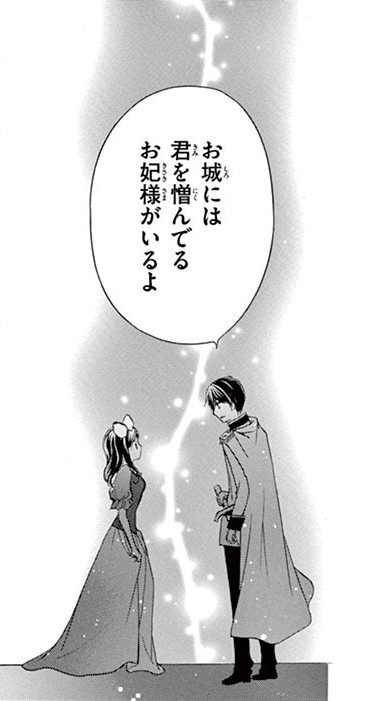
Koharu is playing Snow White in the school’s welcome play, with Tsuzuki as the prince. Tsuzuki has kept his distance from his mother and her new family, and Koharu invited them to watch. Midway through, she stops the play and announces that Snow White won’t live with the dwarfs or the prince. She will go home to the castle where her mother lives.
- 都築:
- 「お城には君を憎んでるお妃様がいるよ」
- “But the queen who hates you is at that castle.”
Key Points
- 妃 is the native Japanese reading of 妃, used on its own to mean a king’s or emperor’s wife. お and 様 make it polite, the way storybooks refer to royalty.
- In Japanese versions of Snow White, お妃様 is the usual name for the wicked queen. The script for this play also calls the role 王妃, the Sino-Japanese word with the same meaning.
- 憎む means to hate. 憎んでる is the casual contraction of 憎んでいる, describing an ongoing feeling.
- The whole clause 君を憎んでる modifies お妃様: “the queen who hates you”.
- お城には marks the castle as the topic of location: “as for the castle, there is…”. いる says the queen is there.
- The よ tells Snow White something he thinks she has overlooked, turning the remark into a warning.
Vocabulary
| Word | English | Meaning |
|---|---|---|
| 城 | Castle | 城 is a castle, the fortified home of a ruler or lord. Fairy tales often say it politely as お城. |
| 君 | You | 君 is a word for “you” used toward equals or people younger or of lower standing. It sounds gentle or poetic. Read くん, it is a suffix on names. |
| 憎む | To hate | 憎む is to hate or detest someone or something, usually with a deep, lasting resentment. |
| お妃様 | Queen | お妃様 is a polite way to refer to a king’s wife, the queen. Fairy tales use it for queens such as Snow White’s stepmother. |
| いる | To be | いる is to exist or be somewhere, for people and animals. After a て-form verb, it shows an ongoing action or a continuing state. |
See Also
- Kanji: Royal consorts with 妃
- Grammar: Ongoing actions and resulting states with 〜ている
- Grammar: Informing with よ
- Kanji: Forms and appearances with 様