The superb fish caught here with 獲れる
Vocabulary Explanation: Taking, catching, and photographing with とる
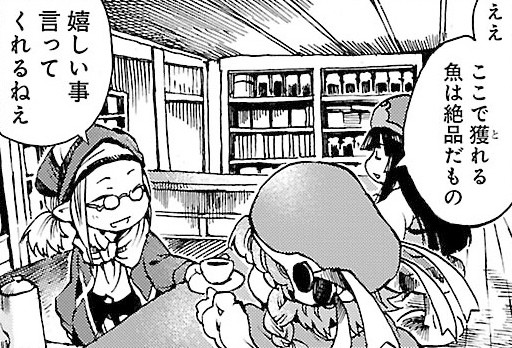
Hakumei and Mikochi are shopping in the port town of Arabi, known for its stacked market, and Mikochi has filled both their baskets with fish. She takes Hakumei to her regular café to leave the shopping there. The master, who hasn’t opened yet, teases her about how much she bought and asks whether she’s stocking up for her cooking again.
- ミコチ:
- 「ええ ここで獲れる魚は絶品だもの」
- “Yes. The fish they catch here are superb, after all.”
- マスター:
- 「嬉しい事言ってくれるねえ」
- “Now that's nice to hear.”
Key Points
- 獲れる is the intransitive partner of 獲る, “catch”. 魚を獲る is someone catching fish. 魚が獲れる is fish being caught, with no catcher in view. Mikochi is talking about what the sea around Arabi yields, so she doesn’t need a fisherman in the sentence.
- ここで獲れる describes 魚: “the fish that are caught here”. As a sentence, it would be ここで魚が獲れる. Here 魚 moves out of the clause to become the noun it describes, so its が goes.
- とれる can also be read as the potential, “fish you can catch here”. For a place and its catch the two readings land in the same spot. A fishing ground where fish can be caught is one where fish get caught.
- The default spelling is 取, and 取れる would be correct here. The 常用漢字表 gives 獲 no とる reading at all. The writer picked 獲, the kanji of 獲物, “prey”, because the fish are a catch from the sea, not something simply taken in hand.
- 捕 would also fit catching fish. 獲 leans toward the haul, what a hunt or a fishing trip brings in, which suits a line about a port’s seafood.
- 絶品 is a superb dish or product, the best of its kind. Mikochi says the local fish is that good.
- だもの ends the sentence with a reason, “after all”. It answers the master’s question about her stocking up: she buys a lot because the fish here is that good. The もの form is softer and more grown-up than もん, which fits Mikochi’s calm tone.
- The master runs the café in this town, so praise for its fish pleases him. 嬉しい事を言う is “say something nice”, with を dropped in speech.
- 〜てくれる treats Mikochi’s words as a favor to him. A literal reading is “you say something that makes me happy”. The drawn-out ねえ makes it a warm exclamation rather than a question.
Vocabulary
| Word | English | Meaning |
|---|---|---|
| ここ | Here | ここ is the place where the speaker is. |
| 獲れる | To be caught | 獲れる is for fish or game to be caught. It also means being able to catch it, or being able to win a prize. |
| 魚 | Fish | 魚 is a fish. |
| 絶品 | Superb item; something exquisite | 絶品 is something of the very best quality, especially a dish or product that is hard to match. |
| 嬉しい | Happy | 嬉しい describes the happy feeling when something good happens to you. |
| 事 | Thing | 事 is an abstract thing, matter, or fact. It also turns a verb phrase into a noun, as in 見た事がある. It is often written こと. |
| 言う | To say | 言う means to say or tell. It can also mean to call something by a particular name. |
| くれる | To give | くれる is for someone to give something to the speaker or the speaker’s side. After a て-form verb, it means someone does something for the speaker. |
| もの | Thing | もの is a physical thing or object. It also appears in many grammar patterns. It is also written 物. |
See Also
- Vocabulary: Taking, catching, and photographing with とる
- Grammar: Casual reasons with 〜もん
- Grammar: Receiving kindness with 〜てくれる
- Kanji: Goods and refinement with 品
- Kanji: Matters and events with 事