The trouble of forgetting about today with せっかく〜のに
Grammar Explanation: Wasted effort with せっかく〜のに
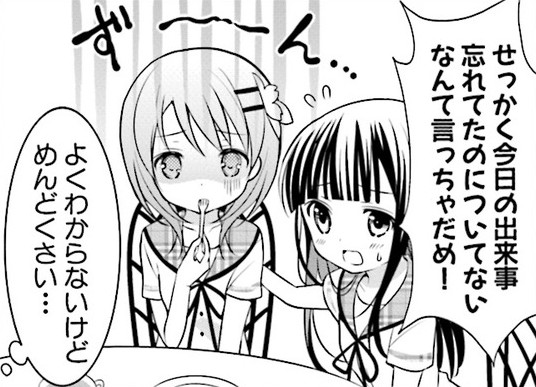
After Cocoa has a string of bad luck throughout the day, Chiya takes her to the tea shop where Syaro works to get her mind off everything that happened.
Just as Cocoa’s finally cheered up, Syaro comments to herself about her own bad luck, returning Cocoa to gloom.
- 千夜:
- 「せっかく今日の出来事忘れてたのについてないなんて言っちゃだめ!」
- “We went through the trouble to forget about today, so don't say bad luck!”
- シャロ:
- 「よくわからないけどめんどくさい…」
- “I don't really understand, but this is a pain...”
Key Points
- Cocoa had reached the welcome state of forgetting the day’s bad events, but Syaro’s comment threatens to undo that progress.
- 今日の出来事忘れてた means she had put what happened that day out of mind.
- 言っちゃ contracts 言っては. Chiya tells Syaro not to say ついてない, because it reminds Cocoa of her bad luck.
- Syaro admits she does not really understand Chiya’s rule, but she can still tell that following it is a nuisance.
Vocabulary
| Word | English | Meaning |
|---|---|---|
| せっかく | With much effort | せっかく marks an effort or valuable opportunity that should not go to waste. Depending on the sentence, it can mean “after taking the trouble” or “since we have the chance”. |
| 今日 | Today | 今日 means today. In formal writing, it can also mean the present day or current era. |
| 出来事 | Event | 出来事 is something that happened, an event or incident. |
| 忘れる | To forget | 忘れる is to forget something. It also means to leave something behind by mistake. |
| ついてない | Unlucky | ついてない describes having bad luck. It is the negative of ついている, “to be in luck”. |
| なんて | Such a thing as | なんて follows a word to treat it lightly or with surprise: “things like” or “such a thing as”. At the start of a phrase, it means “what a…!” |
| 言う | To say | 言う means to say or tell. It can also mean to call something by a particular name. |
| だめ | No good | だめ describes something useless, hopeless, or not allowed. Said alone, it means “no!” or “don’t!” It is also written 駄目. |
| よく | Often | よく means something happens often. It also means “well” or “skillfully”. Before 〜ね, it can show admiration or surprise. |
| わかる | To understand | わかる is to understand something, or for something to become known or clear. It is also written 分かる. |
| めんどくさい | Bothersome | めんどくさい describes something that feels like too much trouble to do. It is a casual form of 面倒くさい. |
See Also
- Grammar: Wasted effort with せっかく〜のに
- Grammar: Past tense with 〜た・〜だ
- Grammar: Negation with 〜ない
- Grammar: Must not do with 〜てはだめだ
- Grammar: Compound voicing with 連濁
- Grammar: Even though with 〜のに
- Kanji: Going out and emerging with 出
- Kanji: Matters and events with 事
- Kanji: Now and the present with 今