The truth isn't always right with 〜わけじゃない
Grammar Explanation: Not necessarily with 〜わけではない
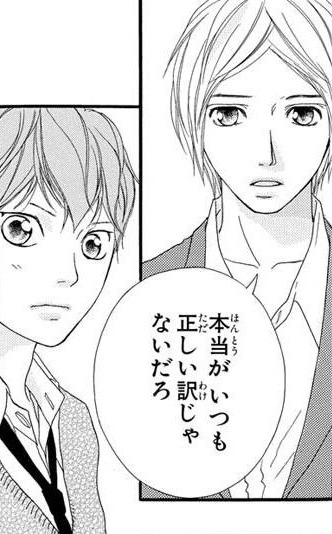
Ninako confessed to Ren and was turned down, since he already has a girlfriend. Manabu has been pushing Ren to admit he has feelings for Ninako. After Ren leaves, Manabu insists to Yuu that Ren really does like her. Yuu answers, “So what?”
- 裕:
- 「本当がいつも正しい訳じゃないだろ」
- “What's true isn't always what's right.”
- Literal: “It isn't the case that the truth is always right, right?”
Key Points
1本当がいつも正しい訳じゃない = “what’s true isn’t always what’s right”
- 訳じゃない is the casual form of わけではない, often written with the kanji 訳. It rejects a conclusion someone might draw. Manabu assumes that since Ren’s feelings are real, he should act on them, and Yuu rejects that.
- With いつも, “always”, the denial covers only the generalization: the truth isn’t right in every case. It may still be right in others.
- 本当 usually means “really” or “true”. Here it works as a noun, “the truth”, meaning Ren’s true feelings.
2Sentence-final だろ = "right?" or "you know"
- だろ is a casual, clipped だろう. Without a question mark, it isn’t really a question. Yuu presses Manabu to see something he treats as obvious.
Vocabulary
本当 (Truth)
本当 is the truth, as opposed to a lie or a joke. ほんとう? asks “really?”
いつも (Always)
いつも describes what happens all the time, or what is normal for someone.
正しい (Correct)
正しい means correct or right, whether factually accurate or morally proper.
訳 (Reason)
訳 is a reason, meaning, or circumstance. It’s the kanji spelling of わけ and appears in the same grammar patterns, such as 訳じゃない, “it’s not that…”.
See Also
- Grammar: Not necessarily with 〜わけではない
- Grammar: Presuming with 〜だろう and 〜でしょう
- Kanji: Matching and appropriateness with 当
- Kanji: Origins and main things with 本
ストロボ・エッジ © its respective creators. It is used here for educational commentary.