The victim must have loved fishing with 釣り好き
Kanji Explanation: Fishing and baiting with 釣
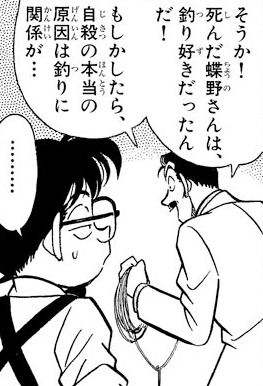
An illustrator, Izumi Chouno, fell from her apartment balcony while Kogoro, Ran, and Conan watched from her boss’s design office a few dozen meters away. The police are calling it suicide, but Conan has figured out how the killer made it look that way. He shows Kogoro a fishing line from the balcony drain, hoping he’ll catch on. Kogoro gets excited and asks an officer whether there’s a fishing tackle shop nearby, and the officer says there is.
- 小五郎:
- 「そうか!死んだ蝶野さんは、釣り好きだったんだ!」
- “I've got it! Ms. Chouno, the dead woman, was a fishing lover!”
- 小五郎:
- 「もしかしたら、自殺の本当の原因は釣りに関係が…」
- “Maybe the real reason for her suicide has something to do with fishing...”
- コナン:
- 「……」
- “...”
Key Points
- 釣り好き describes someone who loves fishing and does it often. Kogoro uses it to call Ms. Chouno a keen angler.
- Noun + 好き means someone who loves that thing, as in きれい好き, someone who likes things neat. 好き changes to ずき in compounds like this, so 釣り好き is read つりずき.
- 釣り on its own is the noun “fishing”, made from the verb 釣る, “to fish”. Kogoro uses it again in his second sentence.
- そうか is what someone says when an idea suddenly clicks. だったんだ adds the explanatory のだ to past だった: Kogoro presents his idea as the hidden fact that explains the line.
- 死んだ蝶野さん is “Ms. Chouno, who died”. The past-tense verb 死んだ describes her, the way English might say “the late Ms. Chouno.”
- 関係がある means “to be connected”. Kogoro stops at 関係が…, leaving off ある or あるのかも, so his guess hangs in the air.
- もしかしたら opens a guess, like “maybe” or “it could be that”.
Vocabulary
| Word | English | Meaning |
|---|---|---|
| そう | So | そう means “like that” or “that way”. Said alone, it agrees: “right”. After a verb stem or adjective, it means something looks or seems a certain way. |
| 死ぬ | To die | 死ぬ is to die. In casual speech, 死んじゃう exaggerates a hardship: “it’ll kill me”. |
| 釣り | Fishing | 釣り is fishing with a rod, line, and hook. In a shop, 釣り, often お釣り, is also the change you get back after paying. |
| 釣り好き | Fishing lover | 釣り好き describes a person who loves fishing and goes often. 好き becomes ずき when it follows another word like this. |
| もしかしたら | Maybe | もしかしたら opens a guess about something that could be true, though the speaker isn’t sure. |
| 自殺 | Suicide | 自殺 is taking one’s own life. In detective stories the first question is often whether a death is 自殺 or 他殺, murder. |
| 本当 | Truth | 本当 is the truth, as opposed to a lie or a joke. ほんとう? asks “really?” |
| 原因 | Cause | 原因 means the cause of a result or condition, often a problem, accident, or failure. |
| 関係 | Relationship | 関係 is how two people or things are connected. 関係ない is the everyday way to say that something has nothing to do with a person or matter. |
See Also
- Kanji: Fishing and baiting with 釣
- Grammar: Reasoning with 〜のだ
- Grammar: Past tense with 〜た・〜だ
- Grammar: Marking the topic with は and も
- Kanji: Causes and dependence with 因
- Kanji: Death and dying with 死
- Kanji: Matching and appropriateness with 当
- Kanji: Origins and main things with 本