They'll target not just me with 〜だけじゃなく〜も
Grammar Explanation: Not only this but also that with 〜だけではなく〜も
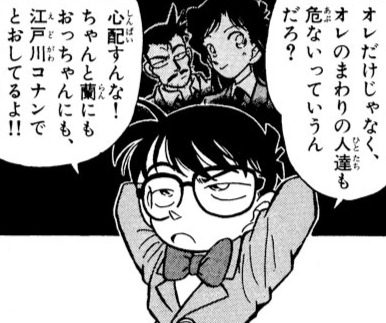
After Shin’ichi was forced to take a deadly drug that instead shrank him back to a child, he took on the undercover name Conan and went to stay with his childhood friend Ran and her detective father in the hope of a lead to the black-clad men who drugged him. He later discusses with Professor Agasa about how useless Detective Mouri is. The professor reminds Conan that the poison was supposed to have killed him, so he can’t rush and let others know his true identity.
- コナン:
- 「オレだけじゃなく、オレのまわりの人達も危ないっていうんだろ?」
- “You're saying it won't be just me, but the people around me will be in danger too, right?”
- 「心配すんな!ちゃんと蘭にもおっちゃんにも、江戸川コナンでとおしてるよ!!」
- “Don't worry! I'm keeping up the Conan Edogawa act with Ran and the old man, too!!”
Key Points
- Conan starts from オレ, “me”, then immediately widens the risk beyond himself.
- Here だけじゃなく means “not just…” and sets up the next phrase as another included target.
- オレのまわりの人達も means “the people around me too”.
- The full shape is オレだけじゃなく…も: “not just me, but … too”.
- っていう casually quotes or summarizes the other person’s point.
- The ending んだろ asks for confirmation: “that is what you mean, right?”
- すんな is a casual contraction of するな, meaning “don’t do it”.
- Attached to 心配, it becomes a blunt but familiar “Don’t worry!”
- とおす means to stick with something all the way through; here Conan is saying he keeps presenting himself as Conan Edogawa.
- 蘭にもおっちゃんにも uses にも…にも to mean “to both Ran and the old man”.
Vocabulary
オレ (I)
オレ is a katakana spelling of おれ, a casual, masculine word for “I”. It is also written 俺.
じゃない (Isn't)
じゃない is the casual negative of だ: “is not”. With a rising tone, it asks for agreement: “isn’t it?”
まわり (Surroundings)
まわり is the area around someone or something, or the people around them. It is also written 周り.
人達 (People)
人達 means people or a group of people.
危ない (Dangerous)
危ない describes something dangerous or risky. Said alone, it is a warning: “look out!”
心配 (Worry)
心配 means worry, concern, or anxiety about what might go wrong. With する, it means “to worry”.
ちゃんと (Properly)
ちゃんと describes doing something correctly and with care, the way it should be done.
おっちゃん (Mister)
おっちゃん is a casual, friendly word for a middle-aged man, especially in western Japan.
とおす (To keep up)
とおす is to let something pass through. It also means to keep something going to the end, such as an act or a story. It is also written 通す.
See Also
- Grammar: Not only this but also that with 〜だけではなく〜も
- Grammar: Marking the topic with は and も
- Grammar: Presuming with 〜だろう and 〜でしょう
- Grammar: Quoting and reporting with と and って
- Grammar: The prohibitive な
- Grammar: Informing with よ
- Grammar: Compound voicing with 連濁
- Grammar: How casual contractions work
- Kanji: Distribution and arrangement with 配
- Kanji: People and persons with 人
- Kanji: Reaching and attaining with 達