Thinking it cost more with 〜気がする
Grammar Explanation: Thinking or feeling something with 〜気がする
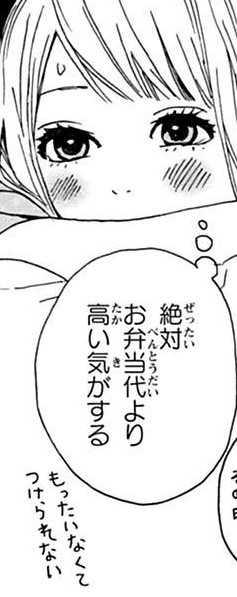
As thanks for Naho making him lunches, Kakeru gives her a jewel-encrusted hair clip. In her room later, Naho looks over the piece.
- 菜穂:
- 「絶対お弁当代より高い気がする」
- “I think it definitely cost more than the lunches.”
- Literal: “I feel like it's definitely more expensive than the lunch cost.”
Key Points
1〜気がする = I feel
- In this pattern, 気 is not “spirit” in a literal sense; the whole phrase expresses a personal impression.
2より makes a comparison
- The comparison is より 高い = “more expensive than”.
3絶対 adds strong confidence, even with a subjective phrase
- 気がする is still an impression, not hard proof.
- But starting with 絶対 makes her sound very convinced of that impression.
4Why this is softer than a direct statement
- Saying 高い alone would sound more definite.
- 「高い気がする」 leaves a little room for uncertainty.
Vocabulary
| Word | English | Meaning |
|---|---|---|
| 絶対 | Absolute | 絶対 means absolute or unconditional. As an adverb, it means definitely or under no circumstances, depending on the sentence. |
| 弁当代 | Lunch money | 弁当代 means lunch money or the price of a boxed meal. |
| より | Than | より marks the thing being compared against: “than”. It can also mean “from”. |
| 高い | High | 高い describes something tall or high. It also means expensive. |
| 気 | Spirit | 気 is a person’s mind, mood, or feelings. It appears in many expressions, such as 気がする, “to have a feeling”. |
| する | To do | する is to do or perform something. It also turns many nouns into verbs, as in 勉強する. |
See Also
orange © its respective creators. It is used here for educational commentary.