Thinking your clothes were baggier with 〜気がする
Grammar Explanation: Thinking or feeling something with 〜気がする
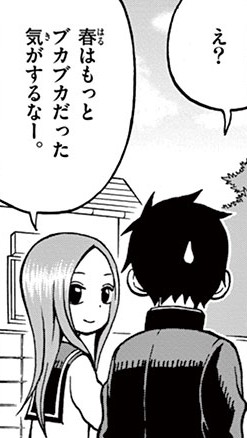
Takagi joins Nishikata as they head to school. They talk about having switched to their winter uniforms as the days are getting colder. Takagi asks Nishikata if he’s gotten taller.
- 西片:
- 「え?」
- “Huh?”
- 高木:
- 「春はもっとブカブカだった気がするなー。」
- “I think your clothes were more baggy back in spring.”
- Literal: “I feel like they were baggier in spring.”
Key Points
1〜気がする = “I feel like” (not 100% certain)
- Here, ブカブカだった気がする is Takagi’s impression that his clothes used to fit looser.
- It softens the claim: she’s not stating a hard fact, more like “It seems…”
2What’s implied: “your clothes” and the subject marker
- The line doesn’t explicitly say “your clothes”; it’s understood from context.
- One reconstruction: 春は(西片の服が)もっとブカブカだった気がするなー.
3春はもっと…だった = “Back in spring, (they) were even more …”
- 春は sets the time/topic: “as for spring / back in spring”.
- もっと means “more / even more” (implying a comparison to now).
- だった makes it past: “were”.
4ブカブカ = “baggy / too loose” (fit/size nuance)
- ブカブカ describes clothing that’s noticeably loose (often “too big for you”).
- In this scene, it hints he may have grown since spring (the clothes don’t look as loose now).
5Ending nuance: なー = casual “hmm / you know…” musing
- なー adds a light, reflective tone (“…I think”) rather than a sharp assertion.
Vocabulary
もっと (More)
もっと means more or to a greater degree.
See Also
- Grammar: Thinking or feeling something with 〜気がする
- Future entry: Past tense with 〜た・〜だ
- Grammar: Marking the topic with は and も
からかい上手の高木さん © its respective creators. It is used here for educational commentary.