Thought I would see her face with 〜ようと思う
Grammar Explanation: Thinking of doing with 〜ようと思う
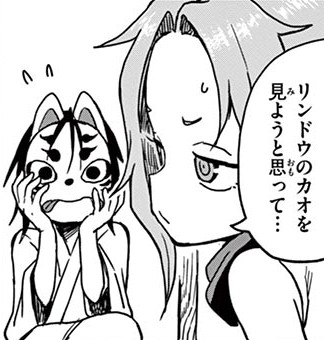
Seeing Rindou asleep, Sazanka reaches for her mask. Rindou wakens and backs away. Tsubaki asks what they’re doing so early in the morning.
- サザンカ:
- 「リンドウのカオを見ようと思って…」
- “I thought I would see Rindou's face...”
- Literal: “Thinking I would see Rindou's face...”
Key Points
1見ようと思って = “I was thinking I’d try to see / get a look at it”
- Pattern: [verb volitional form] + と思う “think / intend to do [verb]”.
- Here 見ようと思って explains Sazanka’s immediate intention just before Rindou woke up.
- The volitional 見よう (from 見る) does not mean simple future here; it shows “I was about to / I was thinking I’d…”
2思って… trails off as an explanation or excuse
- “思って…” leaves the sentence unfinished, like “…that was what I was trying to do”.
- Ending in て makes the line sound softer and more sheepish than a firm, fully closed と思った.
3Non-past form, past intention
- Even though the pattern is based on と思う, the line refers to what Sazanka was thinking a moment earlier.
- In conversation, 〜ようと思って is very natural when giving the reason for an action that was just underway.
- Learners may expect a fully past 〜ようと思った, but the て form fits better when the explanation connects directly to what happened next.
4カオ in katakana adds a casual, manga-like feel
- 顔 is written as カオ for stylistic effect rather than a change in meaning.
- Katakana can make an everyday word feel more blunt, playful, or visually emphasized in dialogue.
Vocabulary
見る (To see)
見る means to see or look at something. It can also mean to examine its condition or nature.
思う (Think)
思う means to think, feel, believe, expect, or hope.
See Also
- Grammar: Thinking of doing with 〜ようと思う
- Grammar: Quoting and reporting with と and って
くノ一ツバキの胸の内 © its respective creators. It is used here for educational commentary.