Told to be more humble with 謙虚
Kanji Explanation: Humility and modesty with 謙
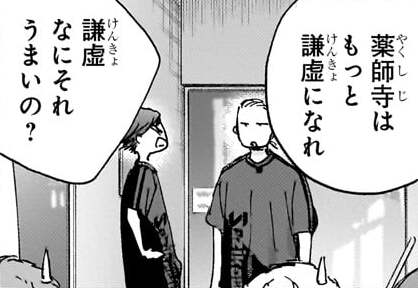
Sachigawa’s top players are on an overseas tour, so they missed the first-year tournament back home. In the lobby of a stadium, they hear that their teammate Mochizuki lost in the semifinals to Taiki of Eimei. Yakushiji laughs that Mochizuki has a self-deprecating streak and would be stronger if he were more straightforward with himself.
- 部員:
- 「薬師寺はもっと謙虚になれ」
- “Yakushiji, you should be more humble.”
- 薬師寺:
- 「謙虚 なにそれ うまいの?」
- “Humble? What's that? Does it taste good?”
Key Points
- 謙虚 describes someone who doesn’t puff themselves up and stays open to other people’s views. It is a な-adjective: 謙虚な人, a humble person.
- Yakushiji has just called Mochizuki 卑屈, servile or self-deprecating. 卑屈 is putting yourself down too far, while 謙虚 is healthy modesty. The club member’s point is that Yakushiji leans too far the other way.
- A な-adjective takes に before なる, “to become”. 謙虚になる means to become humble.
- なれ is the plain imperative of なる. Between teammates it comes across as a blunt “be more humble” rather than a harsh order.
- もっと means “more”. The club member is saying Yakushiji could stand to be more modest than he is.
- なにそれ means “what’s that?” and うまいの? asks “is it tasty?” Together they play on the joke phrase なにそれおいしいの, used to pretend you’ve never heard of something.
- Yakushiji acts as though 謙虚 must be some kind of food, which is his way of admitting, with no shame, that he has none of it.
Vocabulary
| Word | English | Meaning |
|---|---|---|
| もっと | More | もっと describes a greater amount or degree than now, like “more” or “even more”. |
| なる | To become | なる is to change into a different state or become something. It also means something turns out a certain way. It is also written 成る. |
| なに | What | なに asks what something is. Said alone, it shows surprise or annoyance: “what?” It is also written 何. |
| それ | That | それ points to something near the listener, or to something just mentioned. |
| うまい | Good | うまい describes something done with skill, or food that tastes good. For taste, it is more casual than おいしい. |
See Also
- Kanji: Humility and modesty with 謙
- Grammar: Becoming with 〜くなる and 〜になる
- Grammar: The plain imperative