Too accurate fortunes with 〜すぎる
Grammar Explanation: Too much with 〜すぎる
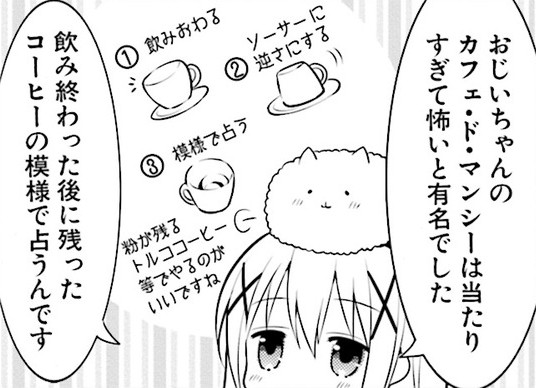
Chino recalls her grandfather’s coffee fortune telling.
- チノ:
- 「おじいちゃんのカフェ・ド・マンシーは当たりすぎて怖いと有名でした」
- “My grandpa's Café de Mancy was famous for being too accurate to a scary degree.”
- Literal: “Grandpa's Café de Mancy was famous because it hit too much and was scary.”
- 「飲み終わった後に残ったコーヒーの模様で占うんです」
- “You tell fortunes from the coffee pattern left after drinking it.”
Key Points
- Fortune predictions “hit” when they come true, so 当たる becomes the English “be accurate” here.
- The て form of すぎる connects the excessive accuracy with 怖い.
- Grandpa’s fortune telling was known for accuracy so strong that customers found it scary.
- The fortune is read only after the coffee has been finished, using the pattern left in the cup.
Vocabulary
| Word | English | Meaning |
|---|---|---|
| おじいちゃん | Grandpa | おじいちゃん is a familiar word for one’s grandfather. People also use it for any elderly man. |
| 当たる | To hit | 当たる is for something to strike or touch something else, like a ball hitting a window or sunlight falling on a room. It also means for a guess to come true, for someone to win a prize, or for one thing to correspond to another, as in 伯父に当たる人. |
| すぎる | Too much | すぎる follows a verb stem or adjective to mean “too much” or “overly”. On its own, it means to pass by or for time to pass. It is also written 過ぎる. |
| 怖い | Scary | 怖い describes something that makes you afraid. |
| 有名 | Famous | 有名 describes someone or something known to many people. |
| 飲む | To drink | 飲む is to drink something, or to take medicine. |
| 終わる | To end | 終わる is for something to come to an end. After a verb stem, it means to finish doing it. |
| 後 | After | 後 is the time after something, the space behind something, or what remains. |
| 残る | To remain | 残る is for something to be left over after the rest is gone. |
| コーヒー | Coffee | コーヒー is coffee, the drink made from roasted coffee beans. |
| 模様 | Pattern | 模様 means a pattern or design. It can also describe how a situation stands or what appears likely to happen. |
| 占う | To tell fortunes | 占う is to predict the future or someone’s fate by some method, such as reading cards or coffee grounds. |
See Also
- Grammar: Too much with 〜すぎる
- Grammar: Past tense with 〜た・〜だ
- Grammar: Marking the topic with は and も
- Grammar: Connecting actions with 〜て・〜で
- Grammar: Completing an action with 〜終わる
- Grammar: Reasoning with 〜のだ
- Grammar: Polite style with です and ます
- Kanji: After and behind with 後
- Kanji: Forms and appearances with 様
- Kanji: Matching and appropriateness with 当