Too cute pajamas with 〜すぎる
Grammar Explanation: Too much with 〜すぎる
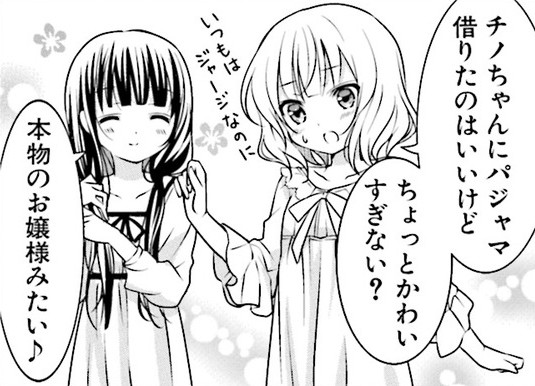
Chiya and Syaro unexpectedly have to stay the night at Chino’s home.
- シャロ:
- 「チノちゃんにパジャマ借りたのはいいけどちょっとかわいすぎない?」
- “Borrowing pajamas from Chino-chan is fine, but aren't they a little too cute?”
- Literal: “Borrowing pajamas from Chino is fine, but aren't they a little too cute?”
- 「いつもはジャージなのに」
- “Even though I usually wear a tracksuit.”
- 千夜:
- 「本物のお嬢様みたい♪」
- “You look like a real young lady♪”
Key Points
- Syaro asks whether the pajamas are too cute, inviting the others to agree with her discomfort.
- のに contrasts Syaro’s usual tracksuit with how refined she looks in Chino’s pajamas.
- みたい makes the resemblance explicit without saying Syaro has literally become one.
- ちゃん is an affectionate, informal suffix attached to names, used mainly for children, close friends, and family members.
Vocabulary
| Word | English | Meaning |
|---|---|---|
| パジャマ | Pajamas | パジャマ is pajamas, clothes worn to sleep. |
| 借りる | To borrow | 借りる is to borrow something from someone. 力を借りる means to get someone’s help. |
| いい | Good | いい describes something good, nice, or fine. It can also mean “okay” or “that’s enough”. Its other forms come from よい, as in よくない and よかった. |
| ちょっと | A little | ちょっと describes a small amount or a short time. It also softens a refusal, or calls someone’s attention, like “hey”. |
| かわいい | Cute | かわいい describes someone or something small, sweet, or charming enough to make you feel fond of it. It is also written 可愛い. |
| いつも | Always | いつも describes what happens all the time, or what is normal for someone. |
| ジャージ | Tracksuit | ジャージ is a tracksuit or sweatsuit, often worn for gym class or around the house. |
| 本物 | Real thing | 本物 is the real or genuine thing, not a copy or fake. |
| お嬢様 | Young lady | お嬢様 is a respectful term for someone’s daughter, especially one from a wealthy family. It can also suggest a sheltered young woman. |
See Also
- Grammar: Too much with 〜すぎる
- Grammar: Past tense with 〜た・〜だ
- Grammar: Marking the topic with は and も
- Grammar: Even though with 〜のに
- Grammar: Likening things with 〜みたい
- Grammar: Negation with 〜ない
- Grammar: But with 〜けど and 〜けれど
- Kanji: Forms and appearances with 様
- Kanji: Origins and main things with 本
- Kanji: Things and kinds with 物